As a tenet of Blake's theory of art, the idea that the outline or lineament was necessary to produce a good work of art, was the most important. He found fault with artists who did not use the technique of outlining the body in their images of human beings. Those familiar with other great artists may find this dictum strange. But Blake had his reason, as usual, related to his ideas of the spiritual being primary, the material secondary.
>From the definition of lineament in Webster's 1913 volume, we learn that lineament is:
"One of the outlines, exterior features, or distinctive marks, of a body or figure, particularly of the face; feature; form; mark;"
>WordNet suggests that lineament is "a characteristic property that defines the apparent individual nature of something."
>From a current usage of lineament in geology we learn that "A lineament is a linear feature in a landscape which is an expression of an underlying geological structure such as a fault."
From Blake's usage it seems he was applying all of these understandings of the word. The outline presented the distinctive features of the object, but not just in an exterior sense. The very individual nature of the thing was inherent in the lineaments. The underlying structure became visible through the outline. Now we see why there is a spiritual dimension to portraying faces, insects, trees, serpents or bodies as outlined; to assist us in seeing not 'with but through the eye.'
A mighty Polypus growing from Albion
Blake on outline and lineament:
Annotations to Reynolds, p 178, (E 657) :
"What does Precision of Pencil mean? If it does not mean Outline it means Nothing"
A Descriptive Catalogue of Blake's Exhibition, Number XV, (E 549):
"When Mr. B. formerly painted in oil colours his Pictures were shewn to certain painters and connoisseurs, who said that they were very admirable Drawings on canvass; but not Pictures: but they said the same of Rafael's Pictures. [P 63] Mr. B. thought this the greatest of compliments, though it was meant otherwise. If losing and obliterating the outline constitutes a Picture, Mr. B. will never be so foolish as to do one. Such art of losing the outlines is the art of Venice and Flanders; it loses all character, and leaves what some people call, expression: but this is a false notion of expression; expression cannot exist without character as its stamina; and neither character nor expression can exist without firm and determinate outline."
A Descriptive Catalogue of Blake's Exhibition, Number XV, (E 550) :
"How do we distinguish the oak from the beech, the horse from the ox, but by the bounding outline? How do we distinguish one face or countenance from another, but by the bounding line and its infinite inflexions and movements? What is it that builds a house and plants a garden, but the definite and determinate? What is it that distinguishes honesty from knavery, but the hard and wirey line of rectitude and certainty [P 65] in the actions and intentions. Leave out this l[i]ne and you leave out life itself; all is chaos again, and the line of the almighty must be drawn out upon it before man or beast can exist."
Jerusalem, Plate 73, (E 229)
"The Sons of Albion are Twelve: the Sons of Jerusalem Sixteen
I tell how Albions Sons by Harmonies of Concords & Discords
Opposed to Melody, and by Lights & Shades, opposed to Outline
And by Abstraction opposed to the Visions of Imagination"
Milton, PLATE 21 [23], (E 115)
"But I knew not that it was Milton, for man cannot know
What passes in his members till periods of Space & Time
Reveal the secrets of Eternity: for more extensive
Than any other earthly things, are Mans earthly lineaments."
Milton, Plate 32, (E 132)
"Judge then of thy Own Self: thy Eternal Lineaments explore
What is Eternal & what Changeable? & what Annihilable!"
Modern science tells us that the brain has structures activated very early in life which give us the ability to recognize faces. This ability could be related to the ability to discern lineament as characteristic of underlying identity or spiritual nature.
Thursday, January 16, 2025

Friday, February 4, 2011
Blake's Urizen
Yes, he had one-- the Urizen within; we all have one: the thinking component of our psyche. We can only begin to understand Blake when we realize that his IQ had to be frightening. You and I might have a sudden thought; Blake had an Explosion-- of Urizen or Luvah, either one and sometimes all together. The average person wants nothing to do with such an individual (that means of course that if you read this, you are Not average.
Blake's mind was infinitely expansible-- and contractable, as in Plate 55 of Jerusalem (E205):
"Let the Human Organs be kept in their perfect Integrity
At will Contracting into Worms, or Expanding into Gods
.........
"Such are these Ulro Visions, for tho we sit down within
The plowed furrow, listning to the weeping clods till we
Contract or Expand Space at will: or if we raise ourselves
Upon the chariots of the morning. Contracting or Expanding Time!
Every one knows, we are One Family! One Man blessed for ever"
(But the Heavenly Visions know nothing of time or space; those are artifacts of the World.)
"Damn braces Bless relaxes." (MHH plate 9; Erdman 37)
In MHH Blake's Energy and Creativity ran away with him; he despised restraints: turn out all the stops; put the volume pedal on the floor. MHH is shocking in the Nth degree, frightening! All his life his problem was self-control (the last of the Gifts of the Spirit). He had no desire for Self-control.
Lucky for Blake he had a wife, a good and faithful wife: indulgent, but she had a limit. (If Nietzsche and Van Gogh had achieved a successful marriage, they might have flamed out so early.
So as we see Blake had a Urizen within. Urizen believed in Control; he gave the Law, and Blake fought him. He also had a Luvah within. Blake fought the first battle with the struggle between Urizen and Luvah; it was a power struggle between the two inner 'gods', and eventually they made a deal: Urizen, the Light Bearer, gave the Sun to Luvah (Luvah took over the South, while Urizen moved to the North (For a while Blake seemed free from the Law and gave himself up to Feeling).
Blake's mind was infinitely expansible-- and contractable, as in Plate 55 of Jerusalem (E205):
"Let the Human Organs be kept in their perfect Integrity
At will Contracting into Worms, or Expanding into Gods
.........
"Such are these Ulro Visions, for tho we sit down within
The plowed furrow, listning to the weeping clods till we
Contract or Expand Space at will: or if we raise ourselves
Upon the chariots of the morning. Contracting or Expanding Time!
Every one knows, we are One Family! One Man blessed for ever"
(But the Heavenly Visions know nothing of time or space; those are artifacts of the World.)
"Damn braces Bless relaxes." (MHH plate 9; Erdman 37)
In MHH Blake's Energy and Creativity ran away with him; he despised restraints: turn out all the stops; put the volume pedal on the floor. MHH is shocking in the Nth degree, frightening! All his life his problem was self-control (the last of the Gifts of the Spirit). He had no desire for Self-control.
Lucky for Blake he had a wife, a good and faithful wife: indulgent, but she had a limit. (If Nietzsche and Van Gogh had achieved a successful marriage, they might have flamed out so early.
So as we see Blake had a Urizen within. Urizen believed in Control; he gave the Law, and Blake fought him. He also had a Luvah within. Blake fought the first battle with the struggle between Urizen and Luvah; it was a power struggle between the two inner 'gods', and eventually they made a deal: Urizen, the Light Bearer, gave the Sun to Luvah (Luvah took over the South, while Urizen moved to the North (For a while Blake seemed free from the Law and gave himself up to Feeling).
"When man lives by Urizen's 'beast-formed science' he is in nonexistence. The change from nonexistence to existence - the change from Satan to Christ" (Percival page 231))
It was a fragile arrangement; Luvah, like Icarus, got too close to the Sun and crashed. Meanwhile Urizen continued his (false) Creation. He went from bad to worse. In his rocky creation he look ahead; Futurity terrified him, took all his ego and left him a quivering failure. Los came in and subdued him (which seems to represent Blake's Imagination getting the best of his fears).
Once Los had won the battle he found his hatred of Urizen melting away; he found he loved him; he rehabilitated him, so that Urizen was now able to recognize and accept a New Lord.
In Jerusalem 98 Blake told of the final reconciliation of Urizen, Luvah, Urthona, and Tharmas. It is the Apocalypse, the End of Eternal Death leading to Eternal Life, when we graduate from Mortal Life, all is United into the One Man (as in John 17:21).
It was a fragile arrangement; Luvah, like Icarus, got too close to the Sun and crashed. Meanwhile Urizen continued his (false) Creation. He went from bad to worse. In his rocky creation he look ahead; Futurity terrified him, took all his ego and left him a quivering failure. Los came in and subdued him (which seems to represent Blake's Imagination getting the best of his fears).
Once Los had won the battle he found his hatred of Urizen melting away; he found he loved him; he rehabilitated him, so that Urizen was now able to recognize and accept a New Lord.
In Jerusalem 98 Blake told of the final reconciliation of Urizen, Luvah, Urthona, and Tharmas. It is the Apocalypse, the End of Eternal Death leading to Eternal Life, when we graduate from Mortal Life, all is United into the One Man (as in John 17:21).
Tuesday, June 8, 2010
Job Picture 2
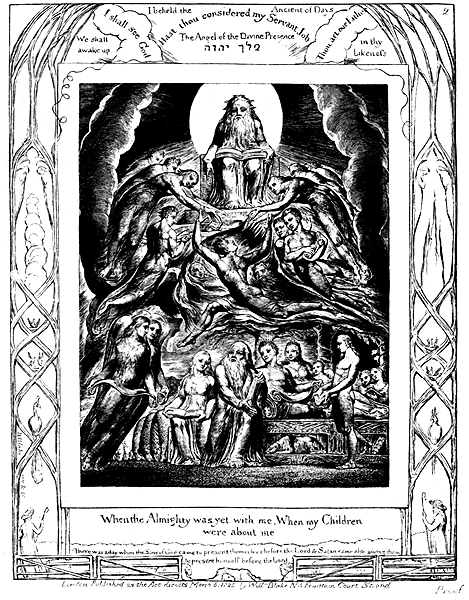
At the top the Establishment God has the BOOK that we're to go by; go by the book, and only good things will happen.
"God is in his Heaven, and all's right with the world." (Browning).
But between the righteous God and the righteous Job and family something strange is happening: look at that strange figure below God, arms and legs spread widely (in violent motion); he's enveloped in fire.
"Hast thou considered my servant Job" inscribed above the picture: the words of God. The picture concerns a conversation God had with Satan (on the left hand of God?) about Job. Back in MHH days the devil wasn't so bad (Blake said Milton "was of the devil's party without knowing it" (MHH plate six). for Blake at that time, in contrast to the passive, Elected, Satan represented the satisfaction of Desire; he represented Revolution: anathema for the Established, longed for by the poor and needy.
Some people's identity rests on the opinion of others; without reflection, they're called outer directed. But the ability to reflect on yourself is required in order to become an individual, and through the 'dark night of the soul' Job will come to see the whole bit, not just the persona or ego, but the shadow (Jung's terms).
The O.T. God was certainly not altogether good; according to Job's code when you behave all is well; when you misbehave there's hell to pay.
Through-out the Illustrations Job's (and our) Innocence are sacrificed by Experience, which is obligatory if you are to grow beyond Goody Two Shoes.
So the Devil is commissioned to test us; after he tested Job, he tested Jesus (in the wilderness), and he tests us. Job met the test; Jesus did, and became our Savior; we may and become sons of God. That's Job's message for us today.
Job: Picture 1
To return to the post move back with
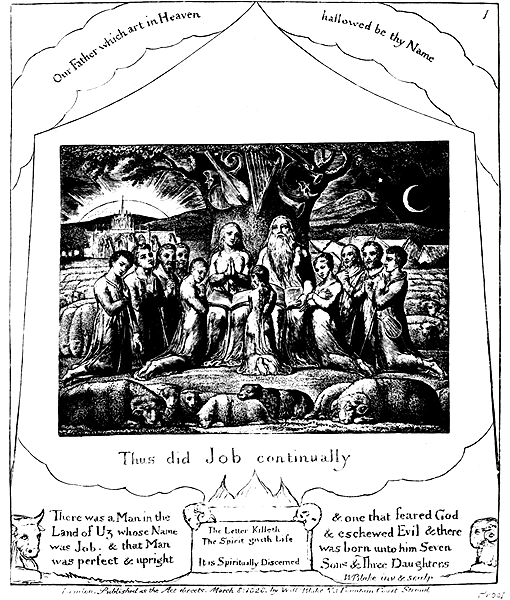
Picture 1 seems right out of the Bible: we see Job with his family (all musicians) gathered around while he and his wife read from the good book and he prays to them. In the top left the sun sets over the cathedral, a symbol of organized religion (of organzied society, government, commerce, and the whole bit). The sun is not to rise again until the end of this dark night.
Such was Job: "blameless and upright; he feared God and shunned evil."
Click on the picture, and then enlarge your font, and you can read the legend(s), of which there are many:
Above the picture you may find the beginning of the Lord's Prayer suggesting an "innocent trusting attitude toward God", an innocence about to be sacrificed.
Beneath the picture proper you may imagine an altar with four animals (perhaps an ox, two lambs, and a ram), where Job offered the sacrifice for possible sins of his children. (This O.T. idea has a parallel in the gospels, where God sacrificed his Son for our sins.)
Edinger p. 17: "Inscribed on the altar are the words, The Letter Killeth. The Spirit giveth Life, indicating that it is the word and Job's reliance on it which are to be sacrificed."
As a fairly young man Blake wrote The Four Zoas, a voluminous work in Nine Nights. Now at 65 he illustrated the Book of Job with a one composite Night. Both works tell the same story.
The text from Job 1:
" In the land of Uz there lived a man whose name was Job. This man was blameless and upright; he feared God and shunned evil. 2 He had seven sons and three daughters, 3 and he owned seven thousand sheep, three thousand camels, five 1 hundred yoke of oxen and five hundred donkeys, and had a large number of servants. He was the greatest man among all the people of the East."
4 His sons used to take turns holding feasts in their homes, and they would invite their three sisters to eat and drink with them. 5 When a period of feasting had run its course, Job would send and have them purified. Early in the morning he would sacrifice a burnt offering for each of them, thinking, "Perhaps my children have sinned and cursed God in their hearts." This was Job's regular custom."
Friday, March 12, 2010
Blake's worm
Blake used the worm as a minor but important symbol in his poetry; you may find 87 occurrences of the word in his Complete Works. He used it to express many different, contrasting or even opposite things. Let's begin with Thel:
Thel, Plate 3, (E 5)
" ...Every thing that lives
Blake has been telling us something about ourselves, our psyche, our community, nation, world.
Another important facet of Blake's worm occurs in the Gates of Paradise: (E 269)
"15. The Door of Death I open found, And the Worm weaving in the ground:
16. Thou'rt my Mother, from the womb; Wife, Sister, Daughter, to the tomb;
Among other ideas this evokes something Jesus said about his mother at Matthew 12:46-50:
46While he yet talked to the people, behold, his mother and his brethren stood without, desiring to speak with him.
47Then one said unto him, Behold, thy mother and thy brethren stand without, desiring to speak with thee.
48But he answered and said unto him that told him, Who is my mother? and who are my brethren?
49And he stretched forth his hand toward his disciples, and said, Behold my mother and my brethren!
50For whosoever shall do the will of my Father which is in heaven, the same is my brother, and sister, and mother.
But here we find worm used in a virtually opposite sense,.
Look at Jerusalem Plate 29, (Erdman 175) where the Spectre of Albion pronounces this:
"I am your Rational Power O Albion & that Human Form
You call Divine, is but a Worm seventy inches long
That creeps forth in a night & is dried in the morning sun"
What does the big worm suggest? a purely conventional life, with no imagination or creativity, a kind of man in whom Los and Luvah are simply absent. A man ruled body and soul by the Selfhood.
In Genesis we read that God created Man in his own image, and also that he formed man out of the dust. And following Digby we have two kinds of men: the one represented by Glad Day and the one represented by the worm of 70 inches. But God includes 'Men' and 'worms' as part of the 'whole Creation' that will be redeemed.
Thel, Plate 3, (E 5)
" ...Every thing that lives
Lives not alone nor for itself. Fear not, and I will call
The weak worm from its lowly bed, and thou shalt hear its voice,
Come forth, worm of the silent valley, to thy pensive queen."
The helpless worm arose, and sat upon the Lily's leaf,
And the bright Cloud sail'd on, to find his partner in the vale.
Then Thel astonish'd view'd the Worm upon its dewy bed.
"Art thou a Worm? Image of weakness, art thou but a Worm?
I see thee like an infant wrapped in the Lily's leaf
Ah! weep not, little voice, thou canst not speak, but thou canst weep.
Is this a Worm? I see thee lay helpless and naked, weeping,
And none to answer, none to cherish thee with mother's smiles."
The Clod of Clay heard the Worm's voice and rais'd her pitying head:
She bow'd over the weeping infant, and her life exhal'd
In milky fondness: then on Thel she fix'd her humble eyes.


Blake has been telling us something about ourselves, our psyche, our community, nation, world.
Another important facet of Blake's worm occurs in the Gates of Paradise: (E 269)
"15. The Door of Death I open found, And the Worm weaving in the ground:
16. Thou'rt my Mother, from the womb; Wife, Sister, Daughter, to the tomb;
Among other ideas this evokes something Jesus said about his mother at Matthew 12:46-50:
46While he yet talked to the people, behold, his mother and his brethren stood without, desiring to speak with him.
47Then one said unto him, Behold, thy mother and thy brethren stand without, desiring to speak with thee.
48But he answered and said unto him that told him, Who is my mother? and who are my brethren?
49And he stretched forth his hand toward his disciples, and said, Behold my mother and my brethren!
50For whosoever shall do the will of my Father which is in heaven, the same is my brother, and sister, and mother.
But here we find worm used in a virtually opposite sense,.
Look at Jerusalem Plate 29, (Erdman 175) where the Spectre of Albion pronounces this:
"I am your Rational Power O Albion & that Human Form
You call Divine, is but a Worm seventy inches long
That creeps forth in a night & is dried in the morning sun"
What does the big worm suggest? a purely conventional life, with no imagination or creativity, a kind of man in whom Los and Luvah are simply absent. A man ruled body and soul by the Selfhood.
In Genesis we read that God created Man in his own image, and also that he formed man out of the dust. And following Digby we have two kinds of men: the one represented by Glad Day and the one represented by the worm of 70 inches. But God includes 'Men' and 'worms' as part of the 'whole Creation' that will be redeemed.
Thursday, March 11, 2010
FOURFOLD CHART
Blake had a fourfold vision but the system of fourfold was not exclusive to Blake. Have a look at this chart and see how well Blake's system holds up when comparing it to Greek Mythology and modern Psychology.
Greek Mythology ...Jung............. Blake
Hesperus/Hestia = sensation . = Tharmas/Enion
Apollo/Artemis.... = reason...... = Urizen/Ahania
Ares/Aphrodite... = feeling....... = Luvah/Vala
Hermes/Athena.. = imagination,= Los/Enithrarmon,
...............................intuition......... Urthona
Blake..................... Activity...... Psychology... Psyche
Tharmas/Enion.. = Shepherd . = id............ = unconscious
Urizen/Ahania ... = Plowman... = superego = subconscious
Luvah/Vala .........= Weaver..... = ego..........= conscious
Los/Enithrarmon, = Blacksmith = self...........= collective
Urthona........................................................... unconscious
Level............ Element.. Vision
Ulro........... = Water.. = Single
Generation = Air....... = Twofold
Beulah....... = Fire..... = Threefold
Eden.......... = Earth... = Fourfold
As you can see from the quotations in the previous post about fourfold, Blake has also given each Zoa a sense, a metal, a direction and much more. By using this symbolic language Blake brings forth a rich and diverse pattern of associations which speak to the conscious, subconscious and unconscious levels of our minds.
If you don't think these associations are a good fit, come up with your own system.
Water, Earth, Air, and Fire are shown on pages 4 through 8 of this pdf file of Gates of Paradise.
Greek Mythology ...Jung............. Blake
Hesperus/Hestia = sensation . = Tharmas/Enion
Apollo/Artemis.... = reason...... = Urizen/Ahania
Ares/Aphrodite... = feeling....... = Luvah/Vala
Hermes/Athena.. = imagination,= Los/Enithrarmon,
...............................intuition......... Urthona
Blake..................... Activity...... Psychology... Psyche
Tharmas/Enion.. = Shepherd . = id............ = unconscious
Urizen/Ahania ... = Plowman... = superego = subconscious
Luvah/Vala .........= Weaver..... = ego..........= conscious
Los/Enithrarmon, = Blacksmith = self...........= collective
Urthona........................................................... unconscious
Level............ Element.. Vision
Ulro........... = Water.. = Single
Generation = Air....... = Twofold
Beulah....... = Fire..... = Threefold
Eden.......... = Earth... = Fourfold
As you can see from the quotations in the previous post about fourfold, Blake has also given each Zoa a sense, a metal, a direction and much more. By using this symbolic language Blake brings forth a rich and diverse pattern of associations which speak to the conscious, subconscious and unconscious levels of our minds.
If you don't think these associations are a good fit, come up with your own system.
Water, Earth, Air, and Fire are shown on pages 4 through 8 of this pdf file of Gates of Paradise.
Wednesday, March 10, 2010
The Clod of Clay
Blake's myth posits our pre-existence, like Thel in the pastoral Vale of Har; we all choose material, temporal life. That's why we're here-- for a time! Eventually we will return--whether we will or not.
But like Thel the choice was ours; we chose life; she declined.
Why do those in the 'above' choose mortal life? Who can say? Some do; some don't.
Thel explored the option. She found the end of mortal life fearsome. With a screech she forsook the world and presumably returned to Har.
--------------------------------------
For Blake everything is a man: rocks, clouds, all creatures, the whole Creation"
"Cities are Men....and Rivers & Mountains are also Men; everything is Human, mighty! sublime!" (Jerusalem, Plate 34 [38]; line 46ff; Erdman 180) Also lilies, clouds, worms, a Clod of Clay.
In Thel we meet the Lilly, the Cloud, the Worm, the Clod of Clay. The last one had this to say:
"...on Thel she fix'd her humble eyes;
'O beauty of the vales of Har, we live not for ourselves.
Thou seest me the meanest thing, and so I am indeed:
My bosom of itself is cold, and of itself is dark,
But he that loves the lowly pours his oil upon my head,
And kisses me, and binds his nuptial bands around my breast,
And says: "Thou mother of my children, I have loved thee,
And I have given thee a crown that none can take away."
But how this is, sweet maid, I know not, and I cannot know;
I ponder, and I cannot ponder, yet I live and love.' (Erdman 6)
Such a beautiful passage! the 'Clod of Clay' is the mother of God's children, 'he that loves the lowly'. God promises to redeem the entire Creation. ("the whole Creation groans in travail ......waiting for the Redemption" (Romans 22).
------------------------------------
"Cities are Men, fathers of multitudes, and Rivers & Mount[a]ins Are also Men; every thing is Human, mighty! sublime! (J34.47f; Erdman 180)
And from Milton, Plate 22, 24 line 17ff; (Erdman 117):
"Six Thousand Years Are finishd. I return! both Time & Space obey my will. I in Six Thousand Years walk up and down: for not one Moment Of Time is lost, nor one Event of Space unpermanent. But all remain: every fabric of Six Thousand Years Remains permanent: tho' on the Earth where Satan Fell, and was cut off all things vanish & are seen no more They vanish not from me & mine, we guard them first & last. The generations of men run on in the tide of Time But leave their destind lineaments permanent for ever & ever."
You could construct an elaborate and beautiful cosmology out of that idea:
Jerusalem Plate 99.1; (Erdman 258):
"All Human Forms identified even Tree Metal Earth & Stone. all
Human Forms identified, living going forth & returning wearied
Into the Planetary lives of Years Months Days & Hours reposing And then Awaking into his Bosom in the Life of Immortality."
When we've completely annihilated our Selfhood, our journey is complete:
"When once I did descry the immortal man who cannot die Through evening shades I haste away to close the labors of my day." Gates of Paradise, (E 269)
But like Thel the choice was ours; we chose life; she declined.
Why do those in the 'above' choose mortal life? Who can say? Some do; some don't.
Thel explored the option. She found the end of mortal life fearsome. With a screech she forsook the world and presumably returned to Har.
--------------------------------------
For Blake everything is a man: rocks, clouds, all creatures, the whole Creation"
"Cities are Men....and Rivers & Mountains are also Men; everything is Human, mighty! sublime!" (Jerusalem, Plate 34 [38]; line 46ff; Erdman 180) Also lilies, clouds, worms, a Clod of Clay.
In Thel we meet the Lilly, the Cloud, the Worm, the Clod of Clay. The last one had this to say:
"...on Thel she fix'd her humble eyes;
'O beauty of the vales of Har, we live not for ourselves.
Thou seest me the meanest thing, and so I am indeed:
My bosom of itself is cold, and of itself is dark,
But he that loves the lowly pours his oil upon my head,
And kisses me, and binds his nuptial bands around my breast,
And says: "Thou mother of my children, I have loved thee,
And I have given thee a crown that none can take away."
But how this is, sweet maid, I know not, and I cannot know;
I ponder, and I cannot ponder, yet I live and love.' (Erdman 6)
Such a beautiful passage! the 'Clod of Clay' is the mother of God's children, 'he that loves the lowly'. God promises to redeem the entire Creation. ("the whole Creation groans in travail ......waiting for the Redemption" (Romans 22).
------------------------------------
"Cities are Men, fathers of multitudes, and Rivers & Mount[a]ins Are also Men; every thing is Human, mighty! sublime! (J34.47f; Erdman 180)
And from Milton, Plate 22, 24 line 17ff; (Erdman 117):
"Six Thousand Years Are finishd. I return! both Time & Space obey my will. I in Six Thousand Years walk up and down: for not one Moment Of Time is lost, nor one Event of Space unpermanent. But all remain: every fabric of Six Thousand Years Remains permanent: tho' on the Earth where Satan Fell, and was cut off all things vanish & are seen no more They vanish not from me & mine, we guard them first & last. The generations of men run on in the tide of Time But leave their destind lineaments permanent for ever & ever."
You could construct an elaborate and beautiful cosmology out of that idea:
Jerusalem Plate 99.1; (Erdman 258):
"All Human Forms identified even Tree Metal Earth & Stone. all
Human Forms identified, living going forth & returning wearied
Into the Planetary lives of Years Months Days & Hours reposing And then Awaking into his Bosom in the Life of Immortality."
When we've completely annihilated our Selfhood, our journey is complete:
"When once I did descry the immortal man who cannot die Through evening shades I haste away to close the labors of my day." Gates of Paradise, (E 269)
Tuesday, March 9, 2010
FOURFOLD VISION
The way I remember Larry first developing an interest in studying Blake was from a book we borrowed from the Arlington County Public Library. He had been studying Jung and this book on symbols mentioned that Jung's four functions corresponded to Blake's Four Zoas. With his attention directed to Blake, Larry seemed to 'fall in love'. Although at times he has pursued other interests, studying Blake has since been one of the constants in his life.
The book he originally read, I believe to be George Wingfield Digby's, Symbol and Image in William Blake. On page 26-27 Digby writes: "The 'Four Mighty Ones in every Man' (a phrase taken from 'The Four Zoas'), correspond with the four psychological functions as studied in analytical psychology. The correspondence is as follows. Water represents the body, that is the function of Sensation, Blake's 'Tharmas'; Earth stands for the Intuitive function, Blake's 'Los'; Air for the Thinking function, 'Urizen'; Fire for the feeling function, 'Luvah'. These four functions, or principles, or 'Living Creatures', are called by Blake the 'Four Zoas'. Their rivalries, combats, deprivations, and distress constitute a large part of Blake's myths as they unfold in the prophetic books, especially in 'The Four Zoas'. Blake throughout is intent on describing, by means of symbols and images, psychological states and conflicts, and their solution. The understanding of the Four Elements in this symbolic, psychological way is not peculiar to Blake but has a long tradition behind it, both in Western and Eastern thought."
Here is a passage from Jerusalem which presents some of the symbols Blake associated with his Four Zoas.
Jerusalem, Plate 97, (E 256)
"So spake the Vision of Albion & in him so spake in my hearing
The Universal Father. Then Albion stretchd his hand into
Infinitude.
And took his Bow. Fourfold the Vision for bright beaming Urizen
Layd his hand on the South & took a breathing Bow of carved Gold
Luvah his hand stretch'd to the East & bore a Silver Bow bright shining
Tharmas Westward a Bow of Brass pure flaming richly wrought
Urthona Northward in thick storms a Bow of Iron terrible thundering."
On Plate 92 of Jerusalem we find Jerusalem awakening in human form, surrounded by four sleeping heads: the Four Zoas, almost ready for their resurrection to properly functioning parts of the giant Albion.
And from Milton, Plate 1, (E 95):
"Bring me my Bow of burning gold:
Bring me my Arrows of desire:
Bring me my Spear: O clouds unfold!
Bring me my Chariot of fire!"
In a later post I'll chart some the correspondences of Blake's Fourfold Vision and characters in Greek mythology, and correspondences of other aspects of modern psychological categories.
Other posts on fourfold in Blake include these: Fourfold.
The book he originally read, I believe to be George Wingfield Digby's, Symbol and Image in William Blake. On page 26-27 Digby writes: "The 'Four Mighty Ones in every Man' (a phrase taken from 'The Four Zoas'), correspond with the four psychological functions as studied in analytical psychology. The correspondence is as follows. Water represents the body, that is the function of Sensation, Blake's 'Tharmas'; Earth stands for the Intuitive function, Blake's 'Los'; Air for the Thinking function, 'Urizen'; Fire for the feeling function, 'Luvah'. These four functions, or principles, or 'Living Creatures', are called by Blake the 'Four Zoas'. Their rivalries, combats, deprivations, and distress constitute a large part of Blake's myths as they unfold in the prophetic books, especially in 'The Four Zoas'. Blake throughout is intent on describing, by means of symbols and images, psychological states and conflicts, and their solution. The understanding of the Four Elements in this symbolic, psychological way is not peculiar to Blake but has a long tradition behind it, both in Western and Eastern thought."
Here is a passage from Jerusalem which presents some of the symbols Blake associated with his Four Zoas.
Jerusalem, Plate 97, (E 256)
"So spake the Vision of Albion & in him so spake in my hearing
The Universal Father. Then Albion stretchd his hand into
Infinitude.
And took his Bow. Fourfold the Vision for bright beaming Urizen
Layd his hand on the South & took a breathing Bow of carved Gold
Luvah his hand stretch'd to the East & bore a Silver Bow bright shining
Tharmas Westward a Bow of Brass pure flaming richly wrought
Urthona Northward in thick storms a Bow of Iron terrible thundering."
On Plate 92 of Jerusalem we find Jerusalem awakening in human form, surrounded by four sleeping heads: the Four Zoas, almost ready for their resurrection to properly functioning parts of the giant Albion.
And from Milton, Plate 1, (E 95):
"Bring me my Bow of burning gold:
Bring me my Arrows of desire:
Bring me my Spear: O clouds unfold!
Bring me my Chariot of fire!"
In a later post I'll chart some the correspondences of Blake's Fourfold Vision and characters in Greek mythology, and correspondences of other aspects of modern psychological categories.
Other posts on fourfold in Blake include these: Fourfold.
Monday, March 8, 2010
Blake's Moment of Grace
(This subject was also dealt with in Blake's Life.
The mind form'd manacles that he dealt with in various ways suggest that (in his own mind at least) he was largely free of them.)
With the Gnostics Blake believed that the Creator was an inferior (false) God; he had messed up the world pretty good. (You could find many people nowadays who might agree with that idea.):
Vision of The Last Judgment, E565):
"Thinking as I do that the Creator of this World is a very
Cruel Being & being a Worshipper of Christ I cannot help saying the Son O how unlike the Father
First God Almighty comes with a Thump on the Head
Then Jesus Christ comes with a balm to heal it."
Blake put these words in the mouth of Urizen:
"I am God from Eternity to Eternity"
In 1800 an affluent poet named Hayley offered a house near the sea for Blake and his wife, a real beneficence! He hoped to make a successful artist of Blake painting miniatures; he discouraged Blake's poetry. Blake had already suffered similar attitudes from many, but none had been more beneficent.
We might consider this Blake's last temptation, and he passed it. Note in this letter to Hayley:
"Suddenly, on the day after visiting the Truchsessian Gallery of pictures, I was again enlightened with the light I enjoyed in my youth, and which has for exactly twenty years been closed from me as by a door and by window-shutters.."
The letter reveals that Blake had "annihilated the Selfhood" to the point where he could forgive Hayley for his insensitive insistence that Blake follow his (inferior!!) artistic direction. For Blake it led to the moment of grace, where, his negativities overcome, he could simply appreciate Hayley's hospitality.
Henceforth the 'inferior God' no longer had terrors for Blake; he was too filled with the new God he had found: Jesus, the Forgiveness. He changed from the stern prophet to the happy bearer of good news; he became the ram horn'd with gold.
The mind form'd manacles that he dealt with in various ways suggest that (in his own mind at least) he was largely free of them.)
With the Gnostics Blake believed that the Creator was an inferior (false) God; he had messed up the world pretty good. (You could find many people nowadays who might agree with that idea.):
Vision of The Last Judgment, E565):
"Thinking as I do that the Creator of this World is a very
Cruel Being & being a Worshipper of Christ I cannot help saying the Son O how unlike the Father
First God Almighty comes with a Thump on the Head
Then Jesus Christ comes with a balm to heal it."
Blake put these words in the mouth of Urizen:
"I am God from Eternity to Eternity"
(FZ1-12.23; E307)
( This is a fundamental archetype of Mankind, at least for Blake's culture and for ours.)
A mind form'd manacle indeed, but the one he struggled with for a long time was what he called the main chance. By that I think he meant the need for recognition of his gifts accompanied by an adequate income:
" I myself remember when I thought my pursuits of Art a kind of Criminal Dissipation & neglect of the main chance which I hid my face for not being able to abandon as a Passion which is forbidden by Law & Religion"
" I myself remember when I thought my pursuits of Art a kind of Criminal Dissipation & neglect of the main chance which I hid my face for not being able to abandon as a Passion which is forbidden by Law & Religion"
He rocked along for twenty years writing jewels and painting masterpieces--both of them rather uniformly ignored by the public; also by other poets and painters.
In 1800 an affluent poet named Hayley offered a house near the sea for Blake and his wife, a real beneficence! He hoped to make a successful artist of Blake painting miniatures; he discouraged Blake's poetry. Blake had already suffered similar attitudes from many, but none had been more beneficent.
We might consider this Blake's last temptation, and he passed it. Note in this letter to Hayley:
"Suddenly, on the day after visiting the Truchsessian Gallery of pictures, I was again enlightened with the light I enjoyed in my youth, and which has for exactly twenty years been closed from me as by a door and by window-shutters.."
The letter reveals that Blake had "annihilated the Selfhood" to the point where he could forgive Hayley for his insensitive insistence that Blake follow his (inferior!!) artistic direction. For Blake it led to the moment of grace, where, his negativities overcome, he could simply appreciate Hayley's hospitality.
Henceforth the 'inferior God' no longer had terrors for Blake; he was too filled with the new God he had found: Jesus, the Forgiveness. He changed from the stern prophet to the happy bearer of good news; he became the ram horn'd with gold.
Sunday, March 7, 2010
REVELATIONS
In the last 20 years of his life, after the completion of Jerusalem, Blake became more of a painter than a poet. He attempted to initiate a project which would have placed murals and tempers in public places and private homes. When this was unsuccessful he turned to creating illustrations for the literature he loved, Milton's Paradise Lost and Paradise Regained, Shakespeare, Dante, Chaucer, Bunyan and the Bible. Blake began "to illustrate other poets' visions so the their readers may more easily understand their archetypal significance." (Fearful Symmetry, by Northrup Frey, Page 415)
This illustration for the Book of Revelation is an example of attention he paid to the text he was illustrating and the freedom he used to clarify the significance by his imaginative presentation.
Revelation or the apocalypse was of particular interest to Blake. The Orc cycle or the Circle of Destiny would end when the new age of the spirit begins. The imagery of the Book of Revelation is frightening and hopeful as would be expected when a new age is being born.
Near the climax of Jerusalem we find these words which relate to the image and words from Revelation:
Jerusalem, Plate 98, (E 257)
Blake's image captures the contrast between the threat and the promise.
 Book of Revelations
5:10 They sang a new song and these are the words they sang, "You are worthy to take the scroll, and to open its seals; for you were slain, and have redeemed us to God by your blood out of every tribe and tongue and people and nation, and have made us kings and priests to our God; and we shall reign on the earth."
...
6:1 - Then I watched while the Lamb broke one of the seven seals, and I heard one of the four living creatures say in a voice of thunder, "Come out!"
6:2 - I looked, and before my eyes was a white horse. Its rider carried a bow, and he was given a crown. He rode out conquering and bent on conquest.
6:3 - Then, when the Lamb broke the second seal, I heard the second living creature, cry, "Come out!"
6:4 - And another horse came forth, red in colour. Its rider was given power to deprive the earth of peace, so that men should kill each other. A huge sword was put into his hand.
6:5a - When the Lamb broke the third seal, I heard the third living creature say, "Come out!"
6:5b-6 - I looked again and there before my eyes was a black horse. Its rider had a pair of scales in his hand, and I heard a voice which seemed to come from the four living creatures, saying, "A quart of wheat for a shilling, and three quarts of barley for a shilling - but no tampering with the oil or the wine!"
6:7 - Then, when he broke the fourth seal I heard the voice of the fourth living creature cry, "Come out!"
6:8 - Again I looked, and there appeared a horse sickly green in colour. The name of its rider was death, and the grave followed close behind him. A quarter of the earth was put into their power, to kill with the sword, by famine, by violence, and through the wild beasts of the earth.
This illustration for the Book of Revelation is an example of attention he paid to the text he was illustrating and the freedom he used to clarify the significance by his imaginative presentation.
Revelation or the apocalypse was of particular interest to Blake. The Orc cycle or the Circle of Destiny would end when the new age of the spirit begins. The imagery of the Book of Revelation is frightening and hopeful as would be expected when a new age is being born.
Near the climax of Jerusalem we find these words which relate to the image and words from Revelation:
Jerusalem, Plate 98, (E 257)
"And every Man stood Fourfold, each Four Faces had. One
to the  West
One toward the East One to the South One to the North.
the Horses  Fourfold
And the dim Chaos brightend beneath, above, around! Eyed
as the  Peacock
According to the Human Nerves of Sensation, the Four
Rivers of the Water of Life"
This watercolor represents the vision in the fifth and sixth chapters of the Book of Revelation. Two of the horses of the apocalypse and their riders are represented. Above is the Lamb opening the scroll. The threat of death and destruction is represented in the dark lower half of the picture with Death Riding on a Pale Horse. The hope and promise of the new Jerusalem appears in the Lamb of God surrounded by the light of the sun and the feathers of protection.Blake's image captures the contrast between the threat and the promise.
 Book of Revelations
5:10 They sang a new song and these are the words they sang, "You are worthy to take the scroll, and to open its seals; for you were slain, and have redeemed us to God by your blood out of every tribe and tongue and people and nation, and have made us kings and priests to our God; and we shall reign on the earth."
...
6:1 - Then I watched while the Lamb broke one of the seven seals, and I heard one of the four living creatures say in a voice of thunder, "Come out!"
6:2 - I looked, and before my eyes was a white horse. Its rider carried a bow, and he was given a crown. He rode out conquering and bent on conquest.
6:3 - Then, when the Lamb broke the second seal, I heard the second living creature, cry, "Come out!"
6:4 - And another horse came forth, red in colour. Its rider was given power to deprive the earth of peace, so that men should kill each other. A huge sword was put into his hand.
6:5a - When the Lamb broke the third seal, I heard the third living creature say, "Come out!"
6:5b-6 - I looked again and there before my eyes was a black horse. Its rider had a pair of scales in his hand, and I heard a voice which seemed to come from the four living creatures, saying, "A quart of wheat for a shilling, and three quarts of barley for a shilling - but no tampering with the oil or the wine!"
6:7 - Then, when he broke the fourth seal I heard the voice of the fourth living creature cry, "Come out!"
6:8 - Again I looked, and there appeared a horse sickly green in colour. The name of its rider was death, and the grave followed close behind him. A quarter of the earth was put into their power, to kill with the sword, by famine, by violence, and through the wild beasts of the earth.
Saturday, March 6, 2010
Blake's Life
This is the big one! Like most people Blake's life had two halves:
In the first half Blake loved to hate; his hatreds were multiple:
He hated legalisms of every sort:
"When Satan first the black bow bent
And the Moral Law from the Gospel rent
He forg'd the Law into a Sword
And spilled the blood of mercys Lord"
Jerusalem Plate 22, lines 82-5)
He hated Religion (by which he meant false Religion!); he saw hypocrisy in every facet of Religion:
"Let the Priests of the Raven of dawn, no longer in deadly black, with hoarse note curse the sons of joy. Nor his accepted brethren whom, tyrant, he calls free; lay the bound or build the roof. Nor pale religious letchery call that virginity, that wishes but acts not! For every thing that lives is Holy"
(MHH, Plate 27, lines 10-21, Erdman 45)
He hated War with 104 occurrences of the word:
the Vision of God is fulfilled
The Ancient Man upon the Rock of Albion Awakes,
He listens to the sounds of War astonishd & ashamed;
He sees his Children mock at Faith and deny Providence"
(E130)
"These are the Gods of the Kingdoms of the Earth: in contrarious
And cruel opposition: Element against Element, opposed in War Not Mental, as the Wars of Eternity, but a Corporeal Strife."
In contrast to the corporeal war of this vale of tears Blake sees the Eternals engaging in War and Hunting, mental, not corporeal.
War and Religion are closely associated in Blake's mind (and in mine!):
(E150)
Cambel & Gwendolen wove webs of war & of
Religion, to involve all Albions sons,
and Jerusalem plate 52 (To the Deists) E200:
"the Religion of Jesus, Forgiveness of Sin, can
never be the cause of a War nor of a single
Martyrdom. Those who Martyr others or who cause War are
Deists, but never can be Forgivers of Sin.
The Glory of Christianity is, To Conquer by
Forgiveness. All the Destruction therefore,
in Christian Europe has arisen from Deism,
which is Natural Religion."
In the first half Blake loved to hate; his hatreds were multiple:
He hated legalisms of every sort:
"When Satan first the black bow bent
And the Moral Law from the Gospel rent
He forg'd the Law into a Sword
And spilled the blood of mercys Lord"
Jerusalem Plate 22, lines 82-5)
He hated Religion (by which he meant false Religion!); he saw hypocrisy in every facet of Religion:
"Let the Priests of the Raven of dawn, no longer in deadly black, with hoarse note curse the sons of joy. Nor his accepted brethren whom, tyrant, he calls free; lay the bound or build the roof. Nor pale religious letchery call that virginity, that wishes but acts not! For every thing that lives is Holy"
(MHH, Plate 27, lines 10-21, Erdman 45)
He hated War with 104 occurrences of the word:
PLATE 25 [27] of Milton (E12)1: "The Awakener is come. outstretchd over Europe!the Vision of God is fulfilled
The Ancient Man upon the Rock of Albion Awakes,
He listens to the sounds of War astonishd & ashamed;
He sees his Children mock at Faith and deny Providence"
(E130)
"These are the Gods of the Kingdoms of the Earth: in contrarious
And cruel opposition: Element against Element, opposed in War Not Mental, as the Wars of Eternity, but a Corporeal Strife."
In contrast to the corporeal war of this vale of tears Blake sees the Eternals engaging in War and Hunting, mental, not corporeal.
War and Religion are closely associated in Blake's mind (and in mine!):
(E150)
Cambel & Gwendolen wove webs of war & of
Religion, to involve all Albions sons,
and Jerusalem plate 52 (To the Deists) E200:
"the Religion of Jesus, Forgiveness of Sin, can
never be the cause of a War nor of a single
Martyrdom. Those who Martyr others or who cause War are
Deists, but never can be Forgivers of Sin.
The Glory of Christianity is, To Conquer by
Forgiveness. All the Destruction therefore,
in Christian Europe has arisen from Deism,
which is Natural Religion."
He hated exploitation and oppression of the poor. Study London
He hated materialism:
Vision of the Last Judgment (Erdman 564)
"I assert for My self that I do
not behold the Outward Creation & that to me it
is hindrance & not Action it is as the Dirt
upon my feet No part of Me."
"I assert for My self that I do
not behold the Outward Creation & that to me it
is hindrance & not Action it is as the Dirt
upon my feet No part of Me."
All of Blake's hatreds he lumped together and referred to as the female will, female love and sometimes (unfortunately) just love:
My Shadow (Erdman 476) "Till I turn from Female Love
And root up the Infernal Grove tI shall never worthy be
To Step into Eternity.........Let us agree to give up Love
And root up the infernal grove Then shall we return & see
The worlds of happy Eternity"
And root up the Infernal Grove tI shall never worthy be
To Step into Eternity.........Let us agree to give up Love
And root up the infernal grove Then shall we return & see
The worlds of happy Eternity"
But then came the Moment of Grace, and the second half of life began. At that point forgiveness took the place of hatred:
Annotations to Watson (Erdman 619):
"The Gospel is Forgiveness of Sins & has No Moral Precepts
these belong to Plato & Seneca & Nero"
"The Gospel is Forgiveness of Sins & has No Moral Precepts
these belong to Plato & Seneca & Nero"
Blake was talking to God when he said this:
And throughout all Eternity
I forgive you, you forgive me.
As our dear Redeemer said:
This the Wine, and this the Bread.
Brothers, let us drink the wine and eat the bread.
I forgive you, you forgive me.
As our dear Redeemer said:
This the Wine, and this the Bread.
Brothers, let us drink the wine and eat the bread.
Friday, March 5, 2010
GNOSIS II
In William Blake's Recreation of Gnostic Myth: Resolving the Apparent Incongruities, Sorensen devotes a chapter to gnostic redemption - fitting Blake's spiritual biography in the pattern of Redemption as a gnostic process which involves 'letting go of worldly conceit' and 'the exalting reunion with the divine.'
Quotes from Sorensen:
"There is little doubt that Blake had intuited as early as 1788 the essential nature of gnostic redemption, in which mankind, through gnosis becomes one with God. There Is No Natural Religion [b] declares," He who sees the Infinite in all things sees God....Therefore God becomes as we are, that we may become as he is."...Blake for many years diligently searched outside himself for this revelation. His wide, if eclectic, reading, his attraction to Swedenborg's works, and his hopes for political revolution all point toward the hope of pure revelation even in the chaos of a fallen material world. Blake's disappointment with the systems of the world around him is abundantly clear in the 1790's, but he never stopped hoping for some solution.
"Blake's letter of 23 October 1804 to William Haley specifies exactly what had troubled Blake and what caused Blake's own gnostic 'redemption.' There are two important aspects to this redemption; first, Blake lets go of his former enmity with Haley, under whose patronage Blake had felt so oppressed toward the end of his stay at Felpham. Blake expresses 'pleasure' and 'longing' in the letter to associate with Haley, who was not even remotely on the same spiritual plane as Blake (which fact caused enmity in the first instance). This self-annihilation on Blake's part constitutes the gnostic's final 'letting go' of worldly conceit.
"The second part of the redemption is the exalting reunification with the divine. After visiting an art gallery, Blake becomes 'enlightened', and he refers to the experience as his 'restoration to the light of Art'.
Blake's experience is reported in this Letter To William Hayley, 23 October 1804, (E 756):
..."Suddenly, on the day after visiting the Truchsessian Gallery of pictures, I was again enlightened with the light I enjoyed in my youth, and which has for exactly twenty years been closed from me as by a door and by window-shutters. Consequently I can, with confidence, promise you ocular demonstration of my altered state on the plates I am now engraving after Romney, whose spiritual aid has not a little conduced to my restoration to the light of Art. O the distress I have undergone, and my poor wife with me. Incessantly labouring and incessantly spoiling what I had done well. Every one of my friends was astonished at my faults, and could not assign a reason; they knew my industry and abstinence from every pleasure for the sake of study, and yet--and yet--and yet there wanted the proofs of industry in my works. I thank God with entire confidence that it shall be so no longer--he is become my servant who domineered over me, he is even as a brother who was my enemy. Dear Sir, excuse my enthusiasm or rather madness, for I am really drunk with intellectual vision whenever I take a pencil or graver into my hand, even as I used to be in my youth, and as I have not been for twenty dark, but very profitable years. I thank God that I courageously pursued my course through darkness."
Returning to Sorenson:
"This instance of highly personalized , individual revelation is a hallmark of Christian gnosticism, in which each gnostic adept must personally encounter divine vision; the contemplation or rational study of canonized scripture and submission to ecclesiastical authority are insufficient, according to gnostic scribes, to reveal the true divine cosmology.
...
"This assurance, that poetic genius indeed creates reality, and that gnosis is the recognition of a reality more real than material existence, came to Blake full by 1804, and he could confidently reveal in his poetry and later in his painting the gnostic redemption of mankind, knowing that his word as poet was the harbinger of that redemption. The artist's poetic works and paintings became his spiritual offspring, and Blake (a man) became a member of the divine family, even as his earliest tractates declared."
The book attempts to open one's eyes to the many ways in which Blake exhibits gnostic thought forms in his life and work. It is a short book in scholarly form. It is an individual way of studying Blake, just as the the methods used by Frey, Erdman, Raine, Damon and each author are their individual ways. Although Sorensen has taken an unusual approach for scholarship by not looking for direct influence but for synchronistic, acausal congruence, it is the type of thinking Blake himself did.

An Angel Striding among the Stars
Quotes from Sorensen:
"There is little doubt that Blake had intuited as early as 1788 the essential nature of gnostic redemption, in which mankind, through gnosis becomes one with God. There Is No Natural Religion [b] declares," He who sees the Infinite in all things sees God....Therefore God becomes as we are, that we may become as he is."...Blake for many years diligently searched outside himself for this revelation. His wide, if eclectic, reading, his attraction to Swedenborg's works, and his hopes for political revolution all point toward the hope of pure revelation even in the chaos of a fallen material world. Blake's disappointment with the systems of the world around him is abundantly clear in the 1790's, but he never stopped hoping for some solution.
"Blake's letter of 23 October 1804 to William Haley specifies exactly what had troubled Blake and what caused Blake's own gnostic 'redemption.' There are two important aspects to this redemption; first, Blake lets go of his former enmity with Haley, under whose patronage Blake had felt so oppressed toward the end of his stay at Felpham. Blake expresses 'pleasure' and 'longing' in the letter to associate with Haley, who was not even remotely on the same spiritual plane as Blake (which fact caused enmity in the first instance). This self-annihilation on Blake's part constitutes the gnostic's final 'letting go' of worldly conceit.
"The second part of the redemption is the exalting reunification with the divine. After visiting an art gallery, Blake becomes 'enlightened', and he refers to the experience as his 'restoration to the light of Art'.
Blake's experience is reported in this Letter To William Hayley, 23 October 1804, (E 756):
..."Suddenly, on the day after visiting the Truchsessian Gallery of pictures, I was again enlightened with the light I enjoyed in my youth, and which has for exactly twenty years been closed from me as by a door and by window-shutters. Consequently I can, with confidence, promise you ocular demonstration of my altered state on the plates I am now engraving after Romney, whose spiritual aid has not a little conduced to my restoration to the light of Art. O the distress I have undergone, and my poor wife with me. Incessantly labouring and incessantly spoiling what I had done well. Every one of my friends was astonished at my faults, and could not assign a reason; they knew my industry and abstinence from every pleasure for the sake of study, and yet--and yet--and yet there wanted the proofs of industry in my works. I thank God with entire confidence that it shall be so no longer--he is become my servant who domineered over me, he is even as a brother who was my enemy. Dear Sir, excuse my enthusiasm or rather madness, for I am really drunk with intellectual vision whenever I take a pencil or graver into my hand, even as I used to be in my youth, and as I have not been for twenty dark, but very profitable years. I thank God that I courageously pursued my course through darkness."
Returning to Sorenson:
"This instance of highly personalized , individual revelation is a hallmark of Christian gnosticism, in which each gnostic adept must personally encounter divine vision; the contemplation or rational study of canonized scripture and submission to ecclesiastical authority are insufficient, according to gnostic scribes, to reveal the true divine cosmology.
...
"This assurance, that poetic genius indeed creates reality, and that gnosis is the recognition of a reality more real than material existence, came to Blake full by 1804, and he could confidently reveal in his poetry and later in his painting the gnostic redemption of mankind, knowing that his word as poet was the harbinger of that redemption. The artist's poetic works and paintings became his spiritual offspring, and Blake (a man) became a member of the divine family, even as his earliest tractates declared."
The book attempts to open one's eyes to the many ways in which Blake exhibits gnostic thought forms in his life and work. It is a short book in scholarly form. It is an individual way of studying Blake, just as the the methods used by Frey, Erdman, Raine, Damon and each author are their individual ways. Although Sorensen has taken an unusual approach for scholarship by not looking for direct influence but for synchronistic, acausal congruence, it is the type of thinking Blake himself did.

An Angel Striding among the Stars
Wednesday, March 3, 2010
Blake's Patriotism
That word means different things to different people. For some it means affirmation for every aspect of the tribe or nation and derogation to every aspect of other tribes or nations. We are the greatest in every respect, and all foreigners are inferior. Above all we can never trust a (treacherous) foreigner.
Blake's patriotism is of a different sort. He loved his country and wanted and hoped for the best for his country, and deplored the worst of it-- like the slave trade, the imperial wars, the fantastic wealth and abject poverty which fed off one another, the 'mind-forg'd manacles'.
He loved America; it represented in his mind the freedom for which he longed for his country. He's said to have been present at the Newgate riots in which "many were avowedly pro-American independence".
Those of the Establishment would no doubt have considered this the opposite of patriotism; for some of us not so .
The French Revolution came along in the nineties, and Blake wore a red cap; but when the guillotine became part of it, Blake took off his red cap. In the thirties political revolution no longer had a positive value for Blake.
"But vain the Sword & vain the Bow
They never can work Wars overthrow
The Hermits Prayer & the Widows tear
Alone can free the World from fear
For a Tear is an Intellectual Thing
And a Sigh is the Sword of an Angel King
And the bitter groan of the Martyrs woe
Is an Arrow from the Almighties Bow
The hand of Vengeance found the Bed
To which the Purple Tyrant fled
The iron hand crushd the Tyrants head
And became a Tyrant in his stead"
(From The Grey Monk)
Blake's patriotism is of a different sort. He loved his country and wanted and hoped for the best for his country, and deplored the worst of it-- like the slave trade, the imperial wars, the fantastic wealth and abject poverty which fed off one another, the 'mind-forg'd manacles'.
He loved America; it represented in his mind the freedom for which he longed for his country. He's said to have been present at the Newgate riots in which "many were avowedly pro-American independence".
Those of the Establishment would no doubt have considered this the opposite of patriotism; for some of us not so .
The French Revolution came along in the nineties, and Blake wore a red cap; but when the guillotine became part of it, Blake took off his red cap. In the thirties political revolution no longer had a positive value for Blake.
"But vain the Sword & vain the Bow
They never can work Wars overthrow
The Hermits Prayer & the Widows tear
Alone can free the World from fear
For a Tear is an Intellectual Thing
And a Sigh is the Sword of an Angel King
And the bitter groan of the Martyrs woe
Is an Arrow from the Almighties Bow
The hand of Vengeance found the Bed
To which the Purple Tyrant fled
The iron hand crushd the Tyrants head
And became a Tyrant in his stead"
(From The Grey Monk)
GNOSIS
For centuries the Gnostic movement of the early Christian era was primarily known by critical statements written by those who were trying to eradicate it. In the twentieth century the reappearance of a group of Gnostic writings, which came to be known as theNag Hammadi documents, have allowed us to learn directly what gnostics wrote and practiced.
Peter Sorensen has written a book entitled William Blake's Recreation of Gnostic Myth: Resolving the Apparent Incongruities, in which he "compare[s] Blake's work directly with the Nag Hammadi codices, discovered long after Blake's death." He believes that the new insights on Gnosticism, developed from the Nag Hammadi material can reveal insights into the patterns of gnostic thought in Blake's work.
Sorensen states: "I wish, then to use the Nag Hammadi codices as a touchstone to test the extent and specific features of Blake' gnosticism. Although I will mention again sources from Blake's own time that might have influenced him, I wish to insist that Blake was a gnostic, rather than merely a student of gnosticism." (Page 14)
In The Gnostic Gospels, Elaine Pagels says of the gnostics: "These Christians are now called gnostics, from the Greek word gnosis, usually translated as "knowledge". For those who claim to know nothing about ultimate reality are called agnostic (literally, "not knowing"), the person who claims to know such things is called gnostic ("knowing")...As the gnostics use the term, we could translate it as "insight," for gnosis involves an intuitive process of knowing oneself. And to know oneself, they claimed, is to know human nature and human destiny...Yet to know oneself, at the deepest level, is simultaneously to know God; this is the secret of gnosis."
The gnostic literature which would have been available for Blake to study would have been limited. Sorensen proposes that Blake would have found " 'confirmation' of his gnostic vision in the works [he has] cited, rather than to say that a genuinely gnostic vision can grow out of secondary reading alone."
I think Sorensen is projecting the idea that Blake's circumstances as well as his visions may have disposed him to think like the early Christian era gnostics. The sociological factors present for Blake which he may have shared with the gnostics would have included intellectual isolation, anxiety about possible persecution, and observing destructive conditions in his society. Psychologically, archetypes which structure thought universally and can be recognized by whoever is tuned to their presence, can link Blake with the gnostics. Additionally we can conjecture that Blake and the early gnostics with their inward looking mindsets, and focus on cosmological issues may have processed some of their insights using the same images.
As an example of the parallels which Sorensen sees between the gnostic myth and Blake's myth are Sophia and Vala, two females trapped in materiality. The difficulty both have in extracting themselves from materiality is represented in this passage from:
Four Zoas, Page 126 (E 395)
"Come forth O Vala from the grass & from the silent Dew
Rise from the dews of death for the Eternal Man is Risen
She rises among flowers & looks toward the Eastern clearness
She walks yea runs her feet are wingd on the tops of the bending grass
Her garments rejoice in the vocal wind & her hair glistens with dew
She answerd thus Whose voice is this in the voice of the nourishing air
In the spirit of the morning awaking the Soul from its grassy bed
Where dost thou dwell for it is thee I seek & but for thee
I must have slept Eternally nor have felt the dew of thy morning
Look how the opening dawn advances with vocal harmony
Look how the beams foreshew the rising of some glorious power
The sun is thine he goeth forth in his majestic brightness
O thou creating voice that callest & who shall answer thee
Where dost thou flee O fair one where dost thou seek thy happy place
To yonder brightness there I haste for sure I came from thence
Or I must have slept eternally nor have felt the dew of morning
Eternally thou must have slept nor have felt the morning dew
But for yon nourishing sun tis that by which thou art arisen
The birds adore the sun the beasts rise up & play in his beams
And every flower & every leaf rejoices in his light
Then O thou fair one sit thee down for thou art as the grass
Thou risest in the dew of morning & at night art folded up
Alas am I but as a flower then will I sit me down
Then will I weep then Ill complain & sigh for immortality
And chide my maker thee O Sun that raisedst me to fall
So saying she sat down & wept beneath the apple trees"
Sorensen concludes, "the awakening here is to knowledge"; but the transition is difficult.
Caught in Materiality , Jerusalem Plate 57
Peter Sorensen has written a book entitled William Blake's Recreation of Gnostic Myth: Resolving the Apparent Incongruities, in which he "compare[s] Blake's work directly with the Nag Hammadi codices, discovered long after Blake's death." He believes that the new insights on Gnosticism, developed from the Nag Hammadi material can reveal insights into the patterns of gnostic thought in Blake's work.
Sorensen states: "I wish, then to use the Nag Hammadi codices as a touchstone to test the extent and specific features of Blake' gnosticism. Although I will mention again sources from Blake's own time that might have influenced him, I wish to insist that Blake was a gnostic, rather than merely a student of gnosticism." (Page 14)
In The Gnostic Gospels, Elaine Pagels says of the gnostics: "These Christians are now called gnostics, from the Greek word gnosis, usually translated as "knowledge". For those who claim to know nothing about ultimate reality are called agnostic (literally, "not knowing"), the person who claims to know such things is called gnostic ("knowing")...As the gnostics use the term, we could translate it as "insight," for gnosis involves an intuitive process of knowing oneself. And to know oneself, they claimed, is to know human nature and human destiny...Yet to know oneself, at the deepest level, is simultaneously to know God; this is the secret of gnosis."
The gnostic literature which would have been available for Blake to study would have been limited. Sorensen proposes that Blake would have found " 'confirmation' of his gnostic vision in the works [he has] cited, rather than to say that a genuinely gnostic vision can grow out of secondary reading alone."
I think Sorensen is projecting the idea that Blake's circumstances as well as his visions may have disposed him to think like the early Christian era gnostics. The sociological factors present for Blake which he may have shared with the gnostics would have included intellectual isolation, anxiety about possible persecution, and observing destructive conditions in his society. Psychologically, archetypes which structure thought universally and can be recognized by whoever is tuned to their presence, can link Blake with the gnostics. Additionally we can conjecture that Blake and the early gnostics with their inward looking mindsets, and focus on cosmological issues may have processed some of their insights using the same images.
As an example of the parallels which Sorensen sees between the gnostic myth and Blake's myth are Sophia and Vala, two females trapped in materiality. The difficulty both have in extracting themselves from materiality is represented in this passage from:
Four Zoas, Page 126 (E 395)
"Come forth O Vala from the grass & from the silent Dew
Rise from the dews of death for the Eternal Man is Risen
She rises among flowers & looks toward the Eastern clearness
She walks yea runs her feet are wingd on the tops of the bending grass
Her garments rejoice in the vocal wind & her hair glistens with dew
She answerd thus Whose voice is this in the voice of the nourishing air
In the spirit of the morning awaking the Soul from its grassy bed
Where dost thou dwell for it is thee I seek & but for thee
I must have slept Eternally nor have felt the dew of thy morning
Look how the opening dawn advances with vocal harmony
Look how the beams foreshew the rising of some glorious power
The sun is thine he goeth forth in his majestic brightness
O thou creating voice that callest & who shall answer thee
Where dost thou flee O fair one where dost thou seek thy happy place
To yonder brightness there I haste for sure I came from thence
Or I must have slept eternally nor have felt the dew of morning
Eternally thou must have slept nor have felt the morning dew
But for yon nourishing sun tis that by which thou art arisen
The birds adore the sun the beasts rise up & play in his beams
And every flower & every leaf rejoices in his light
Then O thou fair one sit thee down for thou art as the grass
Thou risest in the dew of morning & at night art folded up
Alas am I but as a flower then will I sit me down
Then will I weep then Ill complain & sigh for immortality
And chide my maker thee O Sun that raisedst me to fall
So saying she sat down & wept beneath the apple trees"
Sorensen concludes, "the awakening here is to knowledge"; but the transition is difficult.
Caught in Materiality , Jerusalem Plate 57
Blake's Patriotism
That word means different things to different people. For some it means affirmation for every aspect of the tribe or nation and derogation to every aspect of other tribes or nations. We are the greatest in every respect, and all foreigners are inferior. Above all we can never trust a (treacherous) foreigner.
Blake's patriotism is of a different sort. He loved his country and wanted and hoped for the best for his country, and deplored the worst of it-- like the slave trade, the imperial wars, the fantastic wealth and abject poverty which fed off one another, the 'mind-forg'd manacles'.
He loved America; it represented in his mind the freedom which he longed for for his country. He's said to have been present at the Newgate riots in which "many were avowedly pro-American independence".
Those of the Establishment would no doubt have considered this the opposite of patriotism; for some of us not so .
The French Revolution came along in the nineties, and Blake wore a red cap; but when the guillotine became part of it, Blake took off his red cap. In the thirties political revolution no longer had a positive value for Blake.
"But vain the Sword & vain the Bow
They never can work Wars overthrow
The Hermits Prayer & the Widows tear
Alone can free the World from fear
For a Tear is an Intellectual Thing
And a Sigh is the Sword of an Angel King
And the bitter groan of the Martyrs woe
Is an Arrow from the Almighties Bow
The hand of Vengeance found the Bed
To which the Purple Tyrant fled
The iron hand crushd the Tyrants head
And became a Tyrant in his stead"
(From The Grey Monk)
Blake's patriotism is of a different sort. He loved his country and wanted and hoped for the best for his country, and deplored the worst of it-- like the slave trade, the imperial wars, the fantastic wealth and abject poverty which fed off one another, the 'mind-forg'd manacles'.
He loved America; it represented in his mind the freedom which he longed for for his country. He's said to have been present at the Newgate riots in which "many were avowedly pro-American independence".
Those of the Establishment would no doubt have considered this the opposite of patriotism; for some of us not so .
The French Revolution came along in the nineties, and Blake wore a red cap; but when the guillotine became part of it, Blake took off his red cap. In the thirties political revolution no longer had a positive value for Blake.
"But vain the Sword & vain the Bow
They never can work Wars overthrow
The Hermits Prayer & the Widows tear
Alone can free the World from fear
For a Tear is an Intellectual Thing
And a Sigh is the Sword of an Angel King
And the bitter groan of the Martyrs woe
Is an Arrow from the Almighties Bow
The hand of Vengeance found the Bed
To which the Purple Tyrant fled
The iron hand crushd the Tyrants head
And became a Tyrant in his stead"
(From The Grey Monk)
Tuesday, March 2, 2010
Blake's God
In early years Blake was exposed to Swedenborg and to the Moravians.
In The Marriage of Heaven and Hell he gave a definitive opinion of the presence of churches (on Plate 11):
The ancient Poets animated all sensible objects with Gods or Geniuses, calling them by the names and adorning them with the properties of woods, rivers, mountains, lakes, cities, nations, and whatever their enlarged & numerous senses could percieve.
And particularly they studied the genius of each city & country, placing it under its mental deity.
Till a system was formed, which some took advantage of & enslav'd the vulgar by attempting to realize or abstract the mental deities from their objects; thus began Priesthood.
" I must Create a System, or be enslav'd by another Mans
(Jerusalem 10.20; Erdman 153)
Many people think that Blake was an atheist. Not so! He was a God-intoxicated man. Frye called him a Bible soaked Protestant. Blake cared enough about God to spend his life thinking about God and Man.
The Bible myth has God creating Man; Following Gnosticism Blake had Something less than God as the Creator. The Divine Man lived in Eternity and sometimes lapsed into Materiality. He rested in Beulah and fell from there into Ulro-- dividing into the Four Zoas.
In The Marriage of Heaven and Hell he gave a definitive opinion of the presence of churches (on Plate 11):
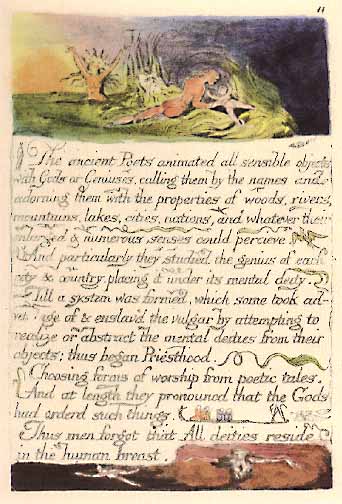
The ancient Poets animated all sensible objects with Gods or Geniuses, calling them by the names and adorning them with the properties of woods, rivers, mountains, lakes, cities, nations, and whatever their enlarged & numerous senses could percieve.
And particularly they studied the genius of each city & country, placing it under its mental deity.
Till a system was formed, which some took advantage of & enslav'd the vulgar by attempting to realize or abstract the mental deities from their objects; thus began Priesthood.
Choosing forms of worship from poetic tales.Re that system he had this to say:
And a length they pronounc'd that the Gods had order'd such things.
Thus men forgot that All deities reside in the human breast.
" I must Create a System, or be enslav'd by another Mans
(Jerusalem 10.20; Erdman 153)
Many people think that Blake was an atheist. Not so! He was a God-intoxicated man. Frye called him a Bible soaked Protestant. Blake cared enough about God to spend his life thinking about God and Man.
The Bible myth has God creating Man; Following Gnosticism Blake had Something less than God as the Creator. The Divine Man lived in Eternity and sometimes lapsed into Materiality. He rested in Beulah and fell from there into Ulro-- dividing into the Four Zoas.
Blake's God
In early years Blake was exposed to Swedenborg and to the Moravians.
In The Marriage of Heaven and Hell he gave a definitive opinion of the presence of churches (on Plate 11):
The ancient Poets animated all sensible objects with Gods or Geniuses, calling them by the names and adorning them with the properties of woods, rivers, mountains, lakes, cities, nations, and whatever their enlarged & numerous senses could percieve.
And particularly they studied the genius of each city & country, placing it under its mental deity.
Till a system was formed, which some took advantage of & enslav'd the vulgar by attempting to realize or abstract the mental deities from their objects; thus began Priesthood.
" I must Create a System, or be enslav'd by another Mans
(Jerusalem 10.20; Erdman 153)
In The Marriage of Heaven and Hell he gave a definitive opinion of the presence of churches (on Plate 11):
The ancient Poets animated all sensible objects with Gods or Geniuses, calling them by the names and adorning them with the properties of woods, rivers, mountains, lakes, cities, nations, and whatever their enlarged & numerous senses could percieve.
And particularly they studied the genius of each city & country, placing it under its mental deity.
Till a system was formed, which some took advantage of & enslav'd the vulgar by attempting to realize or abstract the mental deities from their objects; thus began Priesthood.
Choosing forms of worship from poetic tales.Re that system he had this to say:
And a length they pronounc'd that the Gods had order'd such things.
Thus men forgot that All deities reside in the human breast.
" I must Create a System, or be enslav'd by another Mans
(Jerusalem 10.20; Erdman 153)
Monday, March 1, 2010
GOUGED

I haven't found any definitive information on what caused Blake such anguish that he gouged out the words of love and friendship, and the Greek quotation from Matthew 28 on the engraved copper Plate 3 of Jerusalem. Although it is obvious when looking at the plate that lines have been aggressively removed, there isn't much mention of it. Erdman reconstructed the lines and the are included in The Complete Poetry and Prose of William Blake edited by David V. Erdman. Deletions are seen below in italics.
Jerusalem, Plate 3, (E 145)
"SHEEP....................................................... GOATS
To the Public
After my three years slumber on the banks of the Ocean, I
again display my Giant forms to the Public: My former Giants &
Fairies having reciev'd the highest reward possible: the
[love] and [friendship] of those with whom to
be connected, is to be [blessed]: I cannot doubt that
this more consolidated & extended Work, will be as kindly
recieved
The Enthusiasm of the following Poem, the Author hopes
[no Reader will think presumptuousness or arroganc[e] when he
is reminded that the Ancients acknowledge their love to their
Deities, to the full as Enthusiastically as I have who
Acknowledge mine for my Saviour and Lord, for they were wholly
absorb'd in their Gods.] I also hope the Reader will
be with me, wholly One in Jesus our Lord, who is the God [of
Fire] and Lord [of Love] to whom the Ancients
look'd and saw his day afar off, with trembling & amazement.
The Spirit of Jesus is continual forgiveness of Sin: he who
waits to be righteous before he enters into the Saviours kingdom,
the Divine Body; will never enter there. I am perhaps the most
sinful of men! I pretend not to holiness! yet I pretend to love,
to see, to converse with daily, as man with man, & the more to
have an interest in the Friend of Sinners. Therefore
[Dear] Reader, [forgive] what you do not
approve, & [love] me for this energetic exertion of my
talent.
Reader! [lover] of books! [lover] of
heaven,
And of that God from whom [all books are given,]
Who in mysterious Sinais awful cave
To Man the wond'rous art of writing gave,
Again he speaks in thunder and in fire!
Thunder of Thought, & flames of fierce desire:
Even from the depths of Hell his voice I hear,
Within the unfathomd caverns of my Ear.
Therefore I print; nor vain my types shall be:
Heaven, Earth & Hell, henceforth shall live in harmony
Of the Measure, in which
the following Poem is written
We who dwell on Earth can do nothing of ourselves, every
thing is conducted by Spirits, no less than Digestion or Sleep."
[to Note the last words of Jesus,
p*a*s*a *e*zo*u*s*i*a *e*n o*u*r*a*n*o k*a*i *e*p*i *g*e*s
[(Matthew 28.18, the first words of Jesus' final address to his disciples: "All power is given unto me in heaven and in earth").]
The missing lines came to my attention when I came across this article about the anguish artists experience in conjunction with producing their work and the reception of it. It is a powerful statement from the heart.
Jerusalem Blake
.
TIME / ETERNITY

Larry recently posted a blog concerning the Created Good and the Creative Event. This is a follow-up on the concept of the Created Good presented in Weiman's book.
Quotes from The Source of Human Good, By Henry Nelson Wieman:
"The mere passing through the mind of innumerable meanings is not the creative event. These newly communicated meanings must be integrated with meanings previously acquired or natively developed if the creative event is to occur. This integrating is largely subconscious, unplanned and uncontrolled by the individual, save only as he may provide conditions favorable to its occurrence." Page 59
"The creative event is one that brings forth in the human mind, in society and history, and in the appreciable world a new structure of interrelatedness, whereby events are discriminated and related in a manner not before possible. It is a structure whereby some events derive from other events, through meaningful connection with them, an abundance of quality that events could not have had without this new creation." Page 65
Milton, Plate 28 [30], (E 125)
"But others of the Sons of Los build Moments & Minutes & Hours
And Days & Months & Years & Ages & Periods; wondrous buildings
And every Moment has a Couch of gold for soft repose,
(A Moment equals a pulsation of the artery) ,
And between every two Moments stands a Daughter of Beulah
To feed the Sleepers on their Couches with maternal care.
And every Minute has an azure Tent with silken Veils.
And every Hour has a bright golden Gate carved with skill.
And every Day & Night, has Walls of brass & Gates of adamant,
Shining like precious stones & ornamented with appropriate signs:
And every Month, a silver paved Terrace builded high:
And every Year, invulnerable Barriers with high Towers.
And every Age is Moated deep with Bridges of silver & gold.
And every Seven Ages is Incircled with a Flaming Fire.
Now Seven Ages is amounting to Two Hundred Years
Each has its Guard. each Moment Minute Hour Day Month & Year.
All are the work of Fairy hands of the Four Elements
The Guard are Angels of Providence on duty evermore
Every Time less than a pulsation of the artery
Is equal in its period & value to Six Thousand Years.
PLATE 29 [31]
For in this Period the Poets Work is Done: and all the Great
Events of Time start forth & are concievd in such a Period
Within a Moment: a Pulsation of the Artery."
This is the creative event, Eternity exploding into time's framework.
James Rieger in Sublime Allegory, Page 272, in trying to explain Los' work, has this to say:
"Narrative time is a mere device in Milton and Jerusalem, a sequential representation of two eternal moments that by definition lack extension. Nevertheless, Frye correctly regards one as Resurrection and the other as the Last Judgment, corresponding to the first and second coming of Jesus. Each is its own split-second but one follows the other."
Not the created good but the creative event! Recurring whenever Eternity breaks into time!
Sunday, February 28, 2010
BLAKE & TRADITION
This video of Kathleen Raine, a renowned Blake scholar, talking about Blake can be viewed on youtube. Seen in the video along with Raine is the actor who played Blake in the production about Thomas Paine and William Blake. The actor is Mark Rylance who is known for being the Artistic Director of the Globe Theater.
Video - 'God is the Imagination'
Seeing Kathleen reminds me of how Larry first discovered Kathleen Raine's Blake and Tradition when he was in the sitting room of the National Gallery in Washington DC waiting for me to finish looking at pictures. The Melons were instrumental in envisioning and financing the museum and also sponsored the publication of Raine's book. So that may explain why the book was available there. After that we would sometimes go to the National Gallery just so Larry could read the book, since our local Arlington library didn't have a copy. One cold and rainy Saturday morning we went to the museum but were disappointed - the sitting room was overflowing with anti-war protesters who were looking for a warm spot to dry their clothes and feed their babies. A friend who had a friend who had borrowing privileges at the Library of Congress, borrowed the book for us so that Larry could get a longer look at it.
Read Kathleen Raine's book online.
Of this Title Page of Jerusalem, Raine says: "The soul is depicted under the classical emblem of Psyche, the butterfly. The natural universe of sun, moon, and stars is represented as 'dust on the Fly's wing' of the soul, with whose life they live. The figure at the top of the plate is, following another traditional emblem, bee-winged."
Video - 'God is the Imagination'
Seeing Kathleen reminds me of how Larry first discovered Kathleen Raine's Blake and Tradition when he was in the sitting room of the National Gallery in Washington DC waiting for me to finish looking at pictures. The Melons were instrumental in envisioning and financing the museum and also sponsored the publication of Raine's book. So that may explain why the book was available there. After that we would sometimes go to the National Gallery just so Larry could read the book, since our local Arlington library didn't have a copy. One cold and rainy Saturday morning we went to the museum but were disappointed - the sitting room was overflowing with anti-war protesters who were looking for a warm spot to dry their clothes and feed their babies. A friend who had a friend who had borrowing privileges at the Library of Congress, borrowed the book for us so that Larry could get a longer look at it.
Read Kathleen Raine's book online.
Of this Title Page of Jerusalem, Raine says: "The soul is depicted under the classical emblem of Psyche, the butterfly. The natural universe of sun, moon, and stars is represented as 'dust on the Fly's wing' of the soul, with whose life they live. The figure at the top of the plate is, following another traditional emblem, bee-winged."
Subscribe to:
Posts (Atom)