For centuries the Gnostic movement of the early Christian era was primarily known by critical statements written by those who were trying to eradicate it. In the twentieth century the reappearance of a group of Gnostic writings, which came to be known as theNag Hammadi documents, have allowed us to learn directly what gnostics wrote and practiced.
Peter Sorensen has written a book entitled William Blake's Recreation of Gnostic Myth: Resolving the Apparent Incongruities, in which he "compare[s] Blake's work directly with the Nag Hammadi codices, discovered long after Blake's death." He believes that the new insights on Gnosticism, developed from the Nag Hammadi material can reveal insights into the patterns of gnostic thought in Blake's work.
Sorensen states: "I wish, then to use the Nag Hammadi codices as a touchstone to test the extent and specific features of Blake' gnosticism. Although I will mention again sources from Blake's own time that might have influenced him, I wish to insist that Blake was a gnostic, rather than merely a student of gnosticism." (Page 14)
In The Gnostic Gospels, Elaine Pagels says of the gnostics: "These Christians are now called gnostics, from the Greek word gnosis, usually translated as "knowledge". For those who claim to know nothing about ultimate reality are called agnostic (literally, "not knowing"), the person who claims to know such things is called gnostic ("knowing")...As the gnostics use the term, we could translate it as "insight," for gnosis involves an intuitive process of knowing oneself. And to know oneself, they claimed, is to know human nature and human destiny...Yet to know oneself, at the deepest level, is simultaneously to know God; this is the secret of gnosis."
The gnostic literature which would have been available for Blake to study would have been limited. Sorensen proposes that Blake would have found " 'confirmation' of his gnostic vision in the works [he has] cited, rather than to say that a genuinely gnostic vision can grow out of secondary reading alone."
I think Sorensen is projecting the idea that Blake's circumstances as well as his visions may have disposed him to think like the early Christian era gnostics. The sociological factors present for Blake which he may have shared with the gnostics would have included intellectual isolation, anxiety about possible persecution, and observing destructive conditions in his society. Psychologically, archetypes which structure thought universally and can be recognized by whoever is tuned to their presence, can link Blake with the gnostics. Additionally we can conjecture that Blake and the early gnostics with their inward looking mindsets, and focus on cosmological issues may have processed some of their insights using the same images.
As an example of the parallels which Sorensen sees between the gnostic myth and Blake's myth are Sophia and Vala, two females trapped in materiality. The difficulty both have in extracting themselves from materiality is represented in this passage from:
Four Zoas, Page 126 (E 395)
"Come forth O Vala from the grass & from the silent Dew
Rise from the dews of death for the Eternal Man is Risen
She rises among flowers & looks toward the Eastern clearness
She walks yea runs her feet are wingd on the tops of the bending grass
Her garments rejoice in the vocal wind & her hair glistens with dew
She answerd thus Whose voice is this in the voice of the nourishing air
In the spirit of the morning awaking the Soul from its grassy bed
Where dost thou dwell for it is thee I seek & but for thee
I must have slept Eternally nor have felt the dew of thy morning
Look how the opening dawn advances with vocal harmony
Look how the beams foreshew the rising of some glorious power
The sun is thine he goeth forth in his majestic brightness
O thou creating voice that callest & who shall answer thee
Where dost thou flee O fair one where dost thou seek thy happy place
To yonder brightness there I haste for sure I came from thence
Or I must have slept eternally nor have felt the dew of morning
Eternally thou must have slept nor have felt the morning dew
But for yon nourishing sun tis that by which thou art arisen
The birds adore the sun the beasts rise up & play in his beams
And every flower & every leaf rejoices in his light
Then O thou fair one sit thee down for thou art as the grass
Thou risest in the dew of morning & at night art folded up
Alas am I but as a flower then will I sit me down
Then will I weep then Ill complain & sigh for immortality
And chide my maker thee O Sun that raisedst me to fall
So saying she sat down & wept beneath the apple trees"
Sorensen concludes, "the awakening here is to knowledge"; but the transition is difficult.
Caught in Materiality , Jerusalem Plate 57
Wednesday, March 3, 2010

Blake's Patriotism
That word means different things to different people. For some it means affirmation for every aspect of the tribe or nation and derogation to every aspect of other tribes or nations. We are the greatest in every respect, and all foreigners are inferior. Above all we can never trust a (treacherous) foreigner.
Blake's patriotism is of a different sort. He loved his country and wanted and hoped for the best for his country, and deplored the worst of it-- like the slave trade, the imperial wars, the fantastic wealth and abject poverty which fed off one another, the 'mind-forg'd manacles'.
He loved America; it represented in his mind the freedom which he longed for for his country. He's said to have been present at the Newgate riots in which "many were avowedly pro-American independence".
Those of the Establishment would no doubt have considered this the opposite of patriotism; for some of us not so .
The French Revolution came along in the nineties, and Blake wore a red cap; but when the guillotine became part of it, Blake took off his red cap. In the thirties political revolution no longer had a positive value for Blake.
"But vain the Sword & vain the Bow
They never can work Wars overthrow
The Hermits Prayer & the Widows tear
Alone can free the World from fear
For a Tear is an Intellectual Thing
And a Sigh is the Sword of an Angel King
And the bitter groan of the Martyrs woe
Is an Arrow from the Almighties Bow
The hand of Vengeance found the Bed
To which the Purple Tyrant fled
The iron hand crushd the Tyrants head
And became a Tyrant in his stead"
(From The Grey Monk)
Blake's patriotism is of a different sort. He loved his country and wanted and hoped for the best for his country, and deplored the worst of it-- like the slave trade, the imperial wars, the fantastic wealth and abject poverty which fed off one another, the 'mind-forg'd manacles'.
He loved America; it represented in his mind the freedom which he longed for for his country. He's said to have been present at the Newgate riots in which "many were avowedly pro-American independence".
Those of the Establishment would no doubt have considered this the opposite of patriotism; for some of us not so .
The French Revolution came along in the nineties, and Blake wore a red cap; but when the guillotine became part of it, Blake took off his red cap. In the thirties political revolution no longer had a positive value for Blake.
"But vain the Sword & vain the Bow
They never can work Wars overthrow
The Hermits Prayer & the Widows tear
Alone can free the World from fear
For a Tear is an Intellectual Thing
And a Sigh is the Sword of an Angel King
And the bitter groan of the Martyrs woe
Is an Arrow from the Almighties Bow
The hand of Vengeance found the Bed
To which the Purple Tyrant fled
The iron hand crushd the Tyrants head
And became a Tyrant in his stead"
(From The Grey Monk)
Tuesday, March 2, 2010
Blake's God
In early years Blake was exposed to Swedenborg and to the Moravians.
In The Marriage of Heaven and Hell he gave a definitive opinion of the presence of churches (on Plate 11):
The ancient Poets animated all sensible objects with Gods or Geniuses, calling them by the names and adorning them with the properties of woods, rivers, mountains, lakes, cities, nations, and whatever their enlarged & numerous senses could percieve.
And particularly they studied the genius of each city & country, placing it under its mental deity.
Till a system was formed, which some took advantage of & enslav'd the vulgar by attempting to realize or abstract the mental deities from their objects; thus began Priesthood.
" I must Create a System, or be enslav'd by another Mans
(Jerusalem 10.20; Erdman 153)
Many people think that Blake was an atheist. Not so! He was a God-intoxicated man. Frye called him a Bible soaked Protestant. Blake cared enough about God to spend his life thinking about God and Man.
The Bible myth has God creating Man; Following Gnosticism Blake had Something less than God as the Creator. The Divine Man lived in Eternity and sometimes lapsed into Materiality. He rested in Beulah and fell from there into Ulro-- dividing into the Four Zoas.
In The Marriage of Heaven and Hell he gave a definitive opinion of the presence of churches (on Plate 11):
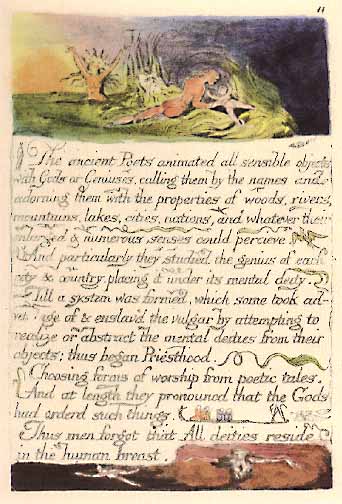
The ancient Poets animated all sensible objects with Gods or Geniuses, calling them by the names and adorning them with the properties of woods, rivers, mountains, lakes, cities, nations, and whatever their enlarged & numerous senses could percieve.
And particularly they studied the genius of each city & country, placing it under its mental deity.
Till a system was formed, which some took advantage of & enslav'd the vulgar by attempting to realize or abstract the mental deities from their objects; thus began Priesthood.
Choosing forms of worship from poetic tales.Re that system he had this to say:
And a length they pronounc'd that the Gods had order'd such things.
Thus men forgot that All deities reside in the human breast.
" I must Create a System, or be enslav'd by another Mans
(Jerusalem 10.20; Erdman 153)
Many people think that Blake was an atheist. Not so! He was a God-intoxicated man. Frye called him a Bible soaked Protestant. Blake cared enough about God to spend his life thinking about God and Man.
The Bible myth has God creating Man; Following Gnosticism Blake had Something less than God as the Creator. The Divine Man lived in Eternity and sometimes lapsed into Materiality. He rested in Beulah and fell from there into Ulro-- dividing into the Four Zoas.
Blake's God
In early years Blake was exposed to Swedenborg and to the Moravians.
In The Marriage of Heaven and Hell he gave a definitive opinion of the presence of churches (on Plate 11):
The ancient Poets animated all sensible objects with Gods or Geniuses, calling them by the names and adorning them with the properties of woods, rivers, mountains, lakes, cities, nations, and whatever their enlarged & numerous senses could percieve.
And particularly they studied the genius of each city & country, placing it under its mental deity.
Till a system was formed, which some took advantage of & enslav'd the vulgar by attempting to realize or abstract the mental deities from their objects; thus began Priesthood.
" I must Create a System, or be enslav'd by another Mans
(Jerusalem 10.20; Erdman 153)
In The Marriage of Heaven and Hell he gave a definitive opinion of the presence of churches (on Plate 11):
The ancient Poets animated all sensible objects with Gods or Geniuses, calling them by the names and adorning them with the properties of woods, rivers, mountains, lakes, cities, nations, and whatever their enlarged & numerous senses could percieve.
And particularly they studied the genius of each city & country, placing it under its mental deity.
Till a system was formed, which some took advantage of & enslav'd the vulgar by attempting to realize or abstract the mental deities from their objects; thus began Priesthood.
Choosing forms of worship from poetic tales.Re that system he had this to say:
And a length they pronounc'd that the Gods had order'd such things.
Thus men forgot that All deities reside in the human breast.
" I must Create a System, or be enslav'd by another Mans
(Jerusalem 10.20; Erdman 153)
Monday, March 1, 2010
GOUGED

I haven't found any definitive information on what caused Blake such anguish that he gouged out the words of love and friendship, and the Greek quotation from Matthew 28 on the engraved copper Plate 3 of Jerusalem. Although it is obvious when looking at the plate that lines have been aggressively removed, there isn't much mention of it. Erdman reconstructed the lines and the are included in The Complete Poetry and Prose of William Blake edited by David V. Erdman. Deletions are seen below in italics.
Jerusalem, Plate 3, (E 145)
"SHEEP....................................................... GOATS
To the Public
After my three years slumber on the banks of the Ocean, I
again display my Giant forms to the Public: My former Giants &
Fairies having reciev'd the highest reward possible: the
[love] and [friendship] of those with whom to
be connected, is to be [blessed]: I cannot doubt that
this more consolidated & extended Work, will be as kindly
recieved
The Enthusiasm of the following Poem, the Author hopes
[no Reader will think presumptuousness or arroganc[e] when he
is reminded that the Ancients acknowledge their love to their
Deities, to the full as Enthusiastically as I have who
Acknowledge mine for my Saviour and Lord, for they were wholly
absorb'd in their Gods.] I also hope the Reader will
be with me, wholly One in Jesus our Lord, who is the God [of
Fire] and Lord [of Love] to whom the Ancients
look'd and saw his day afar off, with trembling & amazement.
The Spirit of Jesus is continual forgiveness of Sin: he who
waits to be righteous before he enters into the Saviours kingdom,
the Divine Body; will never enter there. I am perhaps the most
sinful of men! I pretend not to holiness! yet I pretend to love,
to see, to converse with daily, as man with man, & the more to
have an interest in the Friend of Sinners. Therefore
[Dear] Reader, [forgive] what you do not
approve, & [love] me for this energetic exertion of my
talent.
Reader! [lover] of books! [lover] of
heaven,
And of that God from whom [all books are given,]
Who in mysterious Sinais awful cave
To Man the wond'rous art of writing gave,
Again he speaks in thunder and in fire!
Thunder of Thought, & flames of fierce desire:
Even from the depths of Hell his voice I hear,
Within the unfathomd caverns of my Ear.
Therefore I print; nor vain my types shall be:
Heaven, Earth & Hell, henceforth shall live in harmony
Of the Measure, in which
the following Poem is written
We who dwell on Earth can do nothing of ourselves, every
thing is conducted by Spirits, no less than Digestion or Sleep."
[to Note the last words of Jesus,
p*a*s*a *e*zo*u*s*i*a *e*n o*u*r*a*n*o k*a*i *e*p*i *g*e*s
[(Matthew 28.18, the first words of Jesus' final address to his disciples: "All power is given unto me in heaven and in earth").]
The missing lines came to my attention when I came across this article about the anguish artists experience in conjunction with producing their work and the reception of it. It is a powerful statement from the heart.
Jerusalem Blake
.
TIME / ETERNITY

Larry recently posted a blog concerning the Created Good and the Creative Event. This is a follow-up on the concept of the Created Good presented in Weiman's book.
Quotes from The Source of Human Good, By Henry Nelson Wieman:
"The mere passing through the mind of innumerable meanings is not the creative event. These newly communicated meanings must be integrated with meanings previously acquired or natively developed if the creative event is to occur. This integrating is largely subconscious, unplanned and uncontrolled by the individual, save only as he may provide conditions favorable to its occurrence." Page 59
"The creative event is one that brings forth in the human mind, in society and history, and in the appreciable world a new structure of interrelatedness, whereby events are discriminated and related in a manner not before possible. It is a structure whereby some events derive from other events, through meaningful connection with them, an abundance of quality that events could not have had without this new creation." Page 65
Milton, Plate 28 [30], (E 125)
"But others of the Sons of Los build Moments & Minutes & Hours
And Days & Months & Years & Ages & Periods; wondrous buildings
And every Moment has a Couch of gold for soft repose,
(A Moment equals a pulsation of the artery) ,
And between every two Moments stands a Daughter of Beulah
To feed the Sleepers on their Couches with maternal care.
And every Minute has an azure Tent with silken Veils.
And every Hour has a bright golden Gate carved with skill.
And every Day & Night, has Walls of brass & Gates of adamant,
Shining like precious stones & ornamented with appropriate signs:
And every Month, a silver paved Terrace builded high:
And every Year, invulnerable Barriers with high Towers.
And every Age is Moated deep with Bridges of silver & gold.
And every Seven Ages is Incircled with a Flaming Fire.
Now Seven Ages is amounting to Two Hundred Years
Each has its Guard. each Moment Minute Hour Day Month & Year.
All are the work of Fairy hands of the Four Elements
The Guard are Angels of Providence on duty evermore
Every Time less than a pulsation of the artery
Is equal in its period & value to Six Thousand Years.
PLATE 29 [31]
For in this Period the Poets Work is Done: and all the Great
Events of Time start forth & are concievd in such a Period
Within a Moment: a Pulsation of the Artery."
This is the creative event, Eternity exploding into time's framework.
James Rieger in Sublime Allegory, Page 272, in trying to explain Los' work, has this to say:
"Narrative time is a mere device in Milton and Jerusalem, a sequential representation of two eternal moments that by definition lack extension. Nevertheless, Frye correctly regards one as Resurrection and the other as the Last Judgment, corresponding to the first and second coming of Jesus. Each is its own split-second but one follows the other."
Not the created good but the creative event! Recurring whenever Eternity breaks into time!
Subscribe to:
Posts (Atom)