Anyone may learn to know and love William Blake. Small steps include reading, asking questions, making comments about posts made here (or anywhere else for that matter). We are ordinary people interested in Blake and anxious to meet and converse with any others. Tip: The primary text for Blake is on line. The url is Contents.
Showing posts with label Moravian. Show all posts

Tuesday, March 2, 2010

Blake's God

In early years Blake was exposed to Swedenborg and to the Moravians.

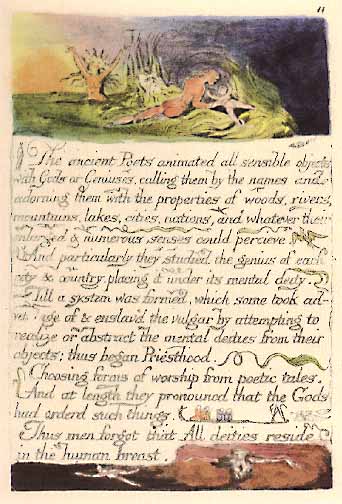
In The Marriage of Heaven and Hell he gave a definitive opinion of the presence of churches (on Plate 11):

The ancient Poets animated all sensible objects with Gods or Geniuses, calling them by the names and adorning them with the properties of woods, rivers, mountains, lakes, cities, nations, and whatever their enlarged & numerous senses could percieve.
And particularly they studied the genius of each city & country, placing it under its mental deity.
Till a system was formed, which some took advantage of & enslav'd the vulgar by attempting to realize or abstract the mental deities from their objects; thus began Priesthood.
Choosing forms of worship from poetic tales.
And a length they pronounc'd that the Gods had order'd such things.
Thus men forgot that All deities reside in the human breast.
Re that system he had this to say:

" I must Create a System, or be enslav'd by another Mans
(Jerusalem 10.20; Erdman 153)

Monday, November 2, 2009

Early Influences on Blake

There's an uncanny similarity between the culture Blake
was born into and the present: The majority culture was
radically materialistic, while an alternative (New Age) one
thrived, especially in religious circles.

Blake's parents were Swedenborgians; his mother had been a
Moravian; these two radically dissenting sects had their due
influence on the young Blake's religious outlook.

Songs of Innocence

Blake enjoyed a happy childhood, with remarkably liberal
and permissive parents; he started school at the appropriate
age, but his academic career was a short one: when the
schoolmaster birched a fellow pupil, little William made a
quick exit and never returned.

Like many such 'dropouts' Blake became an autodidact; he
probably knew more than any person alive of the "perennial
philosophy", the wisdom of the ages. It was a wisdom that
the materialistic culture had turned its back on with the
excessive secularism of the Enlightenment.

In late 18th century England School was for the middle
class, a station to which Blake always aspired. But outside
the middle class boys were generally apprenticed; Blake
became an apprentice to a well regarded engraver.
Thereafter he made his primary income as an engraver;
a great many of his poems were engraved as illuminated
poetry, which Blake practically invented.

Husbands in general tend to be deeply influenced by
their wives, and Blake was no exception. He married an
illiterate woman, but she soon became literate; for 40
years Catherine Blake helped William with his creations and
gave him unlimited encouragement and emotional support.

Re intellectual influences the Bible was first and foremost;
it's hard to find a page of Blake's poetry without a
quotation or at least allusion to some biblical idea.

Second to the Bible is what I called above the 'perennial
philosophy', what Kathleen Raine called the 'canon of the
western esoteric tradition.' It includes an enormous variety
of written material. In a letter he wrote to John Flaxman
when he was 33 Blake only touched the surface:

"Now my lot in the Heavens is this; Milton lovd me in
childhood & shewd me his face Ezra came with Isaiah the
Prophet, but Shakespeare in riper years gave me his hand
Paracelsus & Behmen [Boehme] appeard to me. terrors
appeard in the Heavens above."

One might add Spencer, Dante, and a host of others. Blake
was an inveterate and omnivorous reader; you have to
wonder how he could have accessed all the stuff to which
he had obviously been exposed.

We all encounter influences, both positive and negative. The
primary negative influence Blake felt was the prevailing
materialism; he referred to it as Bacon, Newton and Locke.

Early Influences on Blake

There's an uncanny similarity between the culture Blake
was born into and the present: The majority culture was
radically materialistic, while an alternative (New Age) one
thrived, especially in religious circles.

Blake's parents were Swedenborgians; his mother had been a
Moravian; these two radically dissenting sects had their due
influence on the young Blake's religious outlook.

Songs of Innocence

Blake enjoyed a happy childhood, with remarkably liberal
and permissive parents; he started school at the appropriate
age, but his academic career was a short one: when the
schoolmaster birched a fellow pupil, little William made a
quick exit and never returned.

Like many such 'dropouts' Blake became an autodidact; he
probably knew more than any person alive of the "perennial
philosophy", the wisdom of the ages. It was a wisdom that
the materialistic culture had turned its back on with the
excessive secularism of the Enlightenment.

In late 18th century England School was for the middle
class, a station to which Blake always aspired. But outside
the middle class boys were generally apprenticed; Blake
became an apprentice to a well regarded engraver.
Thereafter he made his primary income as an engraver;
a great many of his poems were engraved as illuminated
poetry, which Blake practically invented.

Husbands in general tend to be deeply influenced by
their wives, and Blake was no exception. He married an
illiterate woman, but she soon became literate; for 40
years Catherine Blake helped William with his creations and
gave him unlimited encouragement and emotional support.

Re intellectual influences the Bible was first and foremost;
it's hard to find a page of Blake's poetry without a
quotation or at least allusion to some biblical idea.

Second to the Bible is what I called above the 'perennial
philosophy', what Kathleen Raine called the 'canon of the
western esoteric tradition.' It includes an enormous variety
of written material. In a letter he wrote to John Flaxman
when he was 33 Blake only touched the surface:

"Now my lot in the Heavens is this; Milton lovd me in
childhood & shewd me his face Ezra came with Isaiah the
Prophet, but Shakespeare in riper years gave me his hand
Paracelsus & Behmen [Boehme] appeard to me. terrors
appeard in the Heavens above."

One might add Spencer, Dante, and a host of others. Blake
was an inveterate and omnivorous reader; you have to
wonder how he could have accessed all the stuff to which
he had obviously been exposed.

We all encounter influences, both positive and negative. The
primary negative influence Blake felt was the prevailing
materialism; he referred to it as Bacon, Newton and Locke.

Tuesday, February 12, 2008

Blake's Vision of God

Of all the Christian spiritual leaders of the past
200 years this British poet would be placed near
the top by any enlightened Christian. God
was the primary theme and motif of his poetry, his
pictures, and his life. His poetry and pictures
contained his revelations of the reality of life,
ultimate reality, which we call God.

At three he ran screaming to his mother after the
sight of a grim punishing God in his window. A few
years later a similar vision embraced a roomful of
angels. Brought up in a Swedenburg and/or
Moravian climate he escaped the common
fallacies that go by the name of Christian
orthodoxy. But the first half of his life he
occupied wrestling with the Old Testament God.

With The Marriage of Heaven and Hell
he inverted the conventional values of good,
obedient, unimaginative church goers (more likely
to idolize and follow their minister than their God).
Blake called them angels, and called those who
ask questions, who think independently, who
experiment, devils.

With Songs of Innocence and Experience he
portrayed first the childlike, who have not met a
judging God, and second those who have tasted that fateful experience.

In his prophetic books Blake exhaustively pictured
the judging God, the Rulemaker and Enforcer
worshipped today by 'fundamentalist'
Christians and Muslims.

Through the years Blake gradually got free from
the baleful influence of a God of Control, used
ainly by the most powerful to control the rest
of us. He came to refer to him as Old Nobodaddy.

In the fullness of time Blake met the God introduced
to us by Jesus: the Loving Heavenly Father. The
gospel was a matter of forgiveness. Most of us have
to forgive (our) God, forgive our parents, our
spouses, most of all ourselves. Blake's First Vision of Light is the moment when he came into that glad awareness. Afterward the old negative ideas of Diety faded away to be replaced by the New Creation characterized by the Gifts of the Spirit.

Image from Songs of Innocence: Jesus and children in LITTLE BLACK BOY. Click on image for enlargement.

Blake's Vision of God

Of all the Christian spiritual leaders of the past
200 years this British poet would be placed near
the top by any enlightened Christian. God
was the primary theme and motif of his poetry, his
pictures, and his life. His poetry and pictures
contained his revelations of the reality of life,
ultimate reality, which we call God.

At three he ran screaming to his mother after the
sight of a grim punishing God in his window. A few
years later a similar vision embraced a roomful of
angels. Brought up in a Swedenburg and/or
Moravian climate he escaped the common
fallacies that go by the name of Christian
orthodoxy. But the first half of his life he
occupied wrestling with the Old Testament God.

With The Marriage of Heaven and Hell
he inverted the conventional values of good,
obedient, unimaginative church goers (more likely
to idolize and follow their minister than their God).
Blake called them angels, and called those who
ask questions, who think independently, who
experiment, devils.

With Songs of Innocence and Experience he
portrayed first the childlike, who have not met a
judging God, and second those who have tasted that fateful experience.

In his prophetic books Blake exhaustively pictured
the judging God, the Rulemaker and Enforcer
worshipped today by 'fundamentalist'
Christians and Muslims.

Through the years Blake gradually got free from
the baleful influence of a God of Control, used
ainly by the most powerful to control the rest
of us. He came to refer to him as Old Nobodaddy.

In the fullness of time Blake met the God introduced
to us by Jesus: the Loving Heavenly Father. The
gospel was a matter of forgiveness. Most of us have
to forgive (our) God, forgive our parents, our
spouses, most of all ourselves. Blake's First Vision of Light is the moment when he came into that glad awareness. Afterward the old negative ideas of Diety faded away to be replaced by the New Creation characterized by the Gifts of the Spirit.

Image from Songs of Innocence: Jesus and children in LITTLE BLACK BOY. Click on image for enlargement.