Anyone may learn to know and love William Blake. Small steps include reading, asking questions, making comments about posts made here (or anywhere else for that matter). We are ordinary people interested in Blake and anxious to meet and converse with any others. Tip: The primary text for Blake is on line. The url is Contents.
Showing posts with label marriage of heaven and hell. Show all posts

Tuesday, March 2, 2010

Blake's God

In early years Blake was exposed to Swedenborg and to the Moravians.

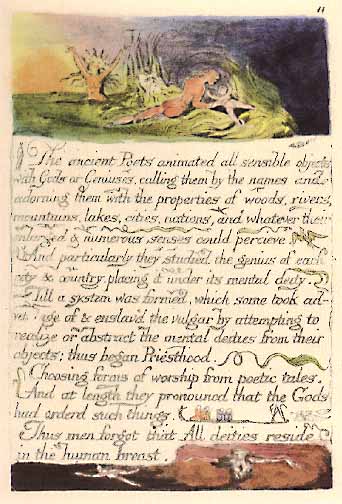
In The Marriage of Heaven and Hell he gave a definitive opinion of the presence of churches (on Plate 11):

The ancient Poets animated all sensible objects with Gods or Geniuses, calling them by the names and adorning them with the properties of woods, rivers, mountains, lakes, cities, nations, and whatever their enlarged & numerous senses could percieve.
And particularly they studied the genius of each city & country, placing it under its mental deity.
Till a system was formed, which some took advantage of & enslav'd the vulgar by attempting to realize or abstract the mental deities from their objects; thus began Priesthood.
Choosing forms of worship from poetic tales.
And a length they pronounc'd that the Gods had order'd such things.
Thus men forgot that All deities reside in the human breast.
Re that system he had this to say:

" I must Create a System, or be enslav'd by another Mans
(Jerusalem 10.20; Erdman 153)

Wednesday, February 24, 2010

The Spectre

In the cold early pre-dawn, sitting beside the fire, full of joy at all life's goodness I wished that I could "annihilate my Selfhood"; then came this Vision straight from Our Heavenly Father:

Like all Blake's metaphors the Spectre has many names:

THE SELFHOOD: you'll find the word 3 times in Milton, Plate 14/15 , but the best statement is at:
Jerusalem, Plate 5

"Trembling I sit day and night, my friends are astonish'd at me. Yet they forgive my wanderings, I rest not from my great task! To open the Eternal Worlds, to open the immortal Eyes Of Man inwards into the Worlds of Thought: into Eternity Ever expanding in the Bosom of God, the Human Imagination, O
Saviour pour upon me thy Spirit of meekness &love:
Annihilate the Selfhood in me, be thou all
my life!"
THE SERPENT: In this picture we see the serpent as the tempter, wrapped around the 'human' form; he might be called Lucifer.

SATAN pervades Blake's works where it occurs 250 times. Here are a few:

In MHH Plate 5 we have the ironic viewpoint of a young Blake. Thereafter his use of Satan varies remarkably through the rest of Blake's works.

The Four Zoas [Nt 4], 56. 19-22 Erdman 338:
"And first he found the Limit of Opacity & namd it Satan
In Albions bosom for in every human bosom these limits stand
And next he found the Limit of Contraction & namd it Adam
While yet those beings were not born nor knew of good or Evil"

We can only puzzle about this one (for a post in the future).

FZ8-113[1st].1-3; E376:
" We behold with wonder Enitharmons Looms & Los's Forges
And the Spindles of Tirzah & Rahab and the Mills of
Satan & Beelzeboul
In Golgonooza Los's anvils stand & his Furnaces rage"

We're in Ulro here, and Los's creative work is competing with the nihilistic "Mills of Satan & Beelzeboul" in his (our) attempt to bring about "God's kingdom on Earth" (But it won't happen!)

FZ8-107[115].22-27; E380:
" And this is the manner in which Satan became the Tempter
There is a State namd Satan learn distinct to know O Rahab
The Difference between States & Individuals of those States
The State namd Satan never can be redeemd in all Eternity
But when Luvah in Orc became a Serpent he des[c]ended into
That State calld Satan"


And you will find many other rich indications of the meanings of Satan for Blake.

THE COVERING CHERUB: Plate 37/41:
"The Virgin answerd. Knowest thou of Milton who descended

Driven from Eternity; him I seek! terrified at my Act
In Great Eternity which thou knowest! I come him to seek
So Ololon utterd in words distinct the anxious thought
Mild was the voice, but more distinct than any earthly
That Miltons Shadow heard & condensing all his Fibres
Into a strength impregnable of majesty & beauty infinite
I saw he was the Covering Cherub & within him Satan
And Raha[b]"

There are many others:

THE MATERIALIST:
All Satan has to do is to keep our minds fixed on materiality and off of anything else.

What it boils down to is that all of these things are in you and in me, and in our community, in our world as well.

on Erdman's Plate 41 of Jerusalem:

"Every man is in his Spectre's power
Until the arrival of that hour
When his Humanity awake
And cast his Spectre into the Lake."
(The mirror image of this appears in the picture.)

Saturday, February 13, 2010

TO OUR READERS

An anonymous reader has asked that we provide more information in our posts. So I will try to explain what we are attempting to do in our Blake blog.

First we want to focus our attention and on William Blake and his writing.

We are not experts but students of Blake. We follow our own interests. We are interested in sharing what we have learned of Blake and would would like to tailor our posts to the interests of the reader. We hope readers will let us know what interests them about Blake.

There have been posts which attempt to introduce the reader to studying Blake especially using the resources on the internet. The links to the text of Blake's poetry and prose, and to his graphic works are provided. A link to Larry's online book which includes a primer is also a useful tool. (These files can be electronically searched for specific topics.) Within the posts we often provide links to external files which expand the study to wider sources.

None of Blake's work is simple to understand. Beginners can start with Songs of Innocence and Experience. Marriage of Heaven and Hell grabs the attention of many with its irony. The major prophecies can be approached a little at a time rather than entire. If you are visually oriented, the visual images can be used as an avenue to draw you into reading the poetry.

Blake's body of work is large and complex. On our blog we have not attempted a systematic study. We are giving clues to solving the mystery. Analysts of Blake's work often tell us that Blake expected the reader to go beyond what was stated in the text, to perceive the underlying meaning. We hope our readers will sift through the blog posts looking for cracks or doors or highways through which they may enter Blake's mind and heart and imagination.

Reading Blake may expand your mind, nourish your spirit, or enrich your imagination; don't expect it to put money in your pocket, expand your social circle or impress your professors.

Here are some earlier posts which may help the neophyte.

Bible
Perception
Vision
Emphasis
Help
Fourfold
Idealism
Reader
Plates
4Z's
_________________
I can't end without a quote from Blake and a picture.

Jerusalem, Plate 60, (E 209)

"within the Furnaces the Divine Vision appeard

On Albions hills: often walking from the Furnaces in clouds
And flames among the Druid Temples & the Starry Wheels
Gatherd Jerusalems Children in his arms & bore them like
A Shepherd in the night of Albion which overspread all the Earth

I gave thee liberty and life O lovely Jerusalem
And thou hast bound me down upon the Stems of Vegetation

Liberty or Stems of Vegetation

Sunday, February 7, 2010

Blake's Bible

Northrup Frye referred to Blake as a Bible soaked Protestant. He was certainly that-- and much more. He read the Bible like no other scholar I've come across. He read it very freely.

In his last years Frye published two large volumes with subtitles: The Bible and Literature. He had started out as a young minister, but made the fatal mistake of studying Blake, after which he became a literary critic-- a real change for the better IMO.

Working on his thesis (called Fearful Symmetry) he had discovered that Blake read the Bible very freely; so he became, yes a Bible soaked Protestant but not (NO, NO!) a bibliolater. He read it more freely than any conforming establishmentarian would dare to do.

In his visions he talked to Isaiah and Ezekiel. Re the cherub God put before the Gate of Eden with a flaming sword Blake had this to say:

"For the cherub with his flaming sword is hereby commanded to leave his guard at the tree of life, and when he does, the whole creation will be consumed, and appear infinite. and holy where as it now appears finite and corrupt. This will come to pass by an improvement of sensual enjoyment."  (MHH, Plate 14)

Just poetry! you might say. Yes, but a fountain of life to non-authoritarians, free spirits who don't feel bound by the inerrancy-of-the-bible crowd. Blake sought Meaning in the Bible, not Law. Bible students divide along that line between free spirits and authoritarian types. Blake belonged to the first category, and so do I, and (hopefully) so do you. Let me know.

Blake's Bible

Northrup Frye referred to Blake as a Bible soaked Protestant. He was certainly that-- and much more. He read the Bible like no other scholar I've come across. He read it very freely.

In his last years Frye published two large volumes with subtitles: The Bible and Literature. He had started out as a young minister, but made the fatal mistake of studying Blake, after which he became a literary critic-- a real change for the better IMO.

Working on his thesis (called Fearful Symmetry) he had discovered that Blake read the Bible very freely; so he became, yes a Bible soaked Protestant but not (NO, NO!) a bibliolater. He read it more freely than any conforming establishmentarian would dare to do.

In his visions he talked to Isaiah and Ezekiel. Re the cherub God put before the Gate of Eden with a flaming sword Blake had this to say:

"For the cherub with his flaming sword is hereby commanded to leave his guard at the tree of life, and when he does, the whole creation will be consumed, and appear infinite. and holy where as it now appears finite and corrupt. This will come to pass by an improvement of sensual enjoyment."  (MHH, Plate 14)

Just poetry! you might say. Yes, but a fountain of life to non-authoritarians, free spirits who don't feel bound by the inerrancy-of-the-bible crowd. Blake sought Meaning in the Bible, not Law. Bible students divide along that line between free spirits and authoritarian types. Blake belonged to the first category, and so do I, and (hopefully) so do you. Let me know.

Friday, January 29, 2010

PERILOUS PATH

June Singer, in her book Seeing Through the Visible World, explores Blake's 'perilous path' in conjunction with Jung's individuation (although she doesn't doesn't mention that term). She associates the dangers of exploring deeper levels of consciousness with encountering the lonely and uncertain struggles of the 'just man'. The reversals of definitions and values which occur as we explore the hidden aspects of the psyche are reflected by the 'just man's' journey on the perilous path.
MHH, Plate 2, (E 33)

She further uses plate 17 of MHH to illuminate the threats in the
"struggles between the side of ego-consciousness and the lesser known shadow side, or in the conflict between inner opposites of the masculine and the feminine, or in the battle between oneself and the tribal gods with their repeated demands for fealty, devotion, and sacrifice."

Marriage of Heaven and Hell, Plate 17, (E 40)
"An Angel came to me and said. O pitiable foolish young man! O horrible! O dreadful state! consider the hot burning dungeon thou art preparing for thyself to all eternity, to which thou art going in such career.
I said. perhaps you will be willing to shew me my eternal lot & we will contemplate together upon it and see whether your lot or mine is most desirable
So he took me thro' a stable & thro' a church & down into the church vault at the end of which was a mill: thro' the mill we went, and came to a cave. down the winding cavern we groped our tedious way till a void boundless as a nether sky appeard beneath us & we held by the roots of trees and hung over this immensity; but I said, if you please we will commit ourselves to this void and see whether providence is here also, if you will not I will? but he answerd. do not presume O young-man but as we here remain behold thy lot which will soon appear when the darkness passes away
So I remaind with him sitting in the twisted root of an oak. he was suspended in a fungus which hung with the head downward into the deep:"

Blake gives an apt warning of the difficulty and danger of undertaking the alteration of the psyche which is initiated by choosing to explore the invisible world.

Which will we choose: the 'perilous path' or the 'paths of ease.'

In the Illuminated Blake, Erdman uses these words to describe this image; "A living form from the abyss".

Wednesday, January 27, 2010

Left the Paths of Ease

You'll find this as a link at the end of the last post. The following re the meek man... is taken from an April 11, 2009 post to the Yahoo Group WmBlake:

Marriage of Heaven and Hell, Plate 2, (E 32)

Blake writes in a language that few people today know, so maybe we need an interpreter. I happen to be reading The Unholy Bible, by June Singer. It's largely an (Jungian) interpretation of MHH. Here are some of her interpretations:

"Rintrah is the personification of rage against the status quo" (and an apt description of the young Blake). Revolution was in the air, and Blake writes about a change (very timely!). The meek man is Joe Six Pack; he hasn't learned to read; his social, political, moral consciousness is minimal, and his exploitation by the 'villain' (let's say bankers) has driven Joe out into the wilderness, but "he's sick and tired, and he's not gonna take it any more." Times will be hard for everybody now.

The meek man and the villain: man is not one, but two. He's "Adam and the serpent, Jacob and Esau, outraged honesty and sneaking hypocrisy".

Speaking of Revolution: France was being bathed in blood, and America had already thrown off the sneaking villain.

So much for the political dimension (Erdman's Blake Prophet Against Empire has more). Psychologically the meek man is the good unconscious church goer; the villain is the Voltarian priest (the first priest was the first villain who met the first fool.) The meek man must some day wake up and gain a critical dimension.

Well I've just scratched the surface. This is poetry; poetry is
never (or at least rarely) about the literal; it's about the
intellectual, the spiritual. The Bible is poetry: beginning to end; not about material events; about spiritual events; events in your consciousness. Blake taught me how to read the Bible. One of his greatest gifts to me.

What does Blake (or the Bible) mean? That depends on you- and me.

Justin said: Justin has left a new comment on your post "Left the Paths of Ease":

This is a strange pronouncement: "poetry is
never (or at least rarely) about the literal; it's about the
intellectual, the spiritual." It's even stranger if you replace poetry with the more general literature: "Literature is never about the literal." But I think it's true somehow. Poetry is the contortion of the literal into the spiritual.

Thursday, January 14, 2010

Perennial Reader

Everyone knows that William Blake was a great reader. What isn't generally known; what is in fact a great mystery is where he got the books or where he did the reading. I haven't succeeded in finding any information about that (tell me if there is any).

Blake went to school for part of one day; that's all the formal education he seems to have acquired. Of course he had some journeyman training. However he appeared to be the most learned person of his generation, which makes him what we call an autodidact -- self-educated.

Very likely his learning began with the Bible; that's demonstrated by the use he made of the Bible in his creative work. He had a thorough acquaintance with the Bible, but he never confined himself to a literal understanding; he didn't see it as history -- no, as poetry. The primary difference is that poetry is susceptible to various meanings, depending on the perception of the reader. Likewise the meaning of any element of the Bible is various, depending on the perception of the reader.

Among the Books of the Bible that he favored he named Ezra and Isaiah; but in MHH he mentioned Ezekiel; he had a conversation with Ezekiel (plate 13). Some of his works demonstrated a considerable acquaintance with Revelation, in the same way that John had shown an extensive acquaintance with The Old Testament.

In a Letter to Flaxman Blake wrote:

"Now my lot in the Heavens is this; Milton
lovd me in childhood & shewd me his face, Ezra
came with Isaiah the Prophet, but Shakespeare in
riper years gave me his hand; Paracelsus & Behmen
appeard to me."

If you're serious about William Blake here's your reading list:

Jacob Boehme
: Aside from the Bible nothing meant more to Blake than William Law's translation of this German mystic (some would say Gnostic). The more of Boehme you read, the more Blake you will see and understand. (the English called him Behmen.)

John Milton: Blake identified strongly with Milton -- and had some marked differences with him. Paradise Lost had a great influence on him. In Plate 6 of MHH he said that Milton "was a true Poet and of the Devils party without knowing it". In Vision, writing The Book of Milton he found it necessary to call Milton back from Heaven to correct his spiritual mistakes (much like God sent his Son to save the world).

Swedenborg: Blake's parents had been attracted to this Swedish philosopher and mystic. He and his wife likely attended the Swedenborg Church in London. But he soon saw the man's deficiencies -- and lampooned him in some early works. He undoubtedly learned something from Swedenborg and lamented about him in Milton, "O Swedenborg! strongest of men, the Samson shorn by the Churches! "

Shakespeare is given by Blake as one of his significant literary relationships. I haven't found that in reading Blake. David Whitmarsh apparently has a lot of say on that score.

Paracelsus
(1493-1541): To learn how this man affected Blake you might best consult Milton Percival's Circle of Destiny (probably the best introduction to Blake). He has a chapter on Alchemical Symbolism, and reading this will help you understand how and why the furnaces come up so often in the major prophecies.

Although Thomas Taylor was one year younger than Blake, his translations of Plato and the Neo-Platonists led our poet's interests emphatically in that direction. Thereafter the Greek and Roman myths loomed large in Blake's poetry and pictures.

Homer was a major source for Blake's works. Although he expressed some contempt for Homer, he drew heavily on Homer's stories, using Ovid more often than Homer himself. To get some understanding of how Blake used Homer take a look at my file on myths. The Sea of Time and Space is directly about the Odyssey, a pictorial description in fact (of course it's about a lot of other things as well).

Hermes Trismegistus
was a special interest of Blake's as well as a dozen similar arcane and esoteric works too numerous to discuss in this post. But perhaps there will be more to come.

Saturday, January 9, 2010

Before the Fall


What was Blake saying with this Picture?

It's about the world, and about everyone:

The biblical source is obvious (Genesis 3), the Garden scene:
Adam and Eve and the snake! Just before the fatal meal that
made us all mortal. But who's the 3rd figure above our
ancestors with the snake all coiled around him? Well Genesis
3 mentions a third figure called "cherubim and a flaming
sword flashing back and forth to guard the way to the tree of
life."

Now look at Blake's myth:
The third figure has a thousand faces: serpent, Satan, Covering Cherub...Urizen! above all the Spectre, the Selfhood!

Blake, the world, you and I are three: masculine, feminine,
and spectrous.

Man and woman work together amicably-- with love;
the spectre, (Satan, Lucifer, Urizen, the Covering Cherub!)
is jealous; his thoughts are evil.

The Fall of Man began Blake's myth, and he wrote many ends (the Bible does as well). One of Blake's earliest and most dramatic ones come in Plate 14 of MHH:

"The ancient tradition that the world will be consumed in fire at the end of six thousand years is true, as I have heard from Hell.

For the cherub with his flaming sword is hereby commanded to leave his guard at tree of life, and when he does, the whole creation will be consumed, and appear infinite, and holy whereas it now appears finite & corrupt."

Once again the poem, My Spectre Round me Night and Day tells the whole story in microcosm.

Sunday, December 27, 2009

TWOFOLD

Blake has given us a treasure of insight, experience, and imagery. The cost to him of producing it was enormous. The reward was the satisfaction of using his innate gifts in expressing his imagination. That he produced a body of work that nourishes us two hundred years after his death, expresses the joy and gratitude with which he exercised his gifts. I like to think that in his case, "Eternity is in love with the productions of time." Marriage of Heaven and Hell, Plate 7, (E36)

From George W. Digby, Symbol and Image in William Blake, Page 19:

"He had as it were two eyes, an eye for the verbal image as it is spoken and written, and an eye for the pictorial image. The inner truth that he apprehended was something other than either of these, not confined or explicit in either of them, but something which could be expressed or implied by their means. For truth, reality, is always beyond the formulation of both words and of pictorial images. Sometimes the pictorial symbol parallels or amplifies the written one; sometimes gives the contrasting aspect, or opposite and contrary point of view. But always this double mode of expression is focused on man's subtle and complex nature, his illusions, self-deceptions, conceits, and his contradictory and insatiable desires. This twofold artistic capacity, and his vision of the infinite which the coarseness and opaqueness of human nature unnecessarily obscures, makes the creative work of Blake in art and poetry such an incomparable source of wisdom."

As Blake wrote in The Four Zoas on Page 35 (E324):


"What is the price of Experience do men buy it for a song
Or wisdom for a dance in the street? No it is bought with the price
Of all that a man hath his house his wife his children
Wisdom is sold in the desolate market where none come to buy
And in the witherd field where the farmer plows for bread in vain"

TWOFOLD

Blake has given us a treasure of insight, experience, and imagery. The cost to him of producing it was enormous. The reward was the satisfaction of using his innate gifts in expressing his imagination. That he produced a body of work that nourishes us two hundred years after his death, expresses the joy and gratitude with which he exercised his gifts. I like to think that in his case, "Eternity is in love with the productions of time." Marriage of Heaven and Hell, Plate 7, (E36)

From George W. Digby, Symbol and Image in William Blake, Page 19:

"He had as it were two eyes, an eye for the verbal image as it is spoken and written, and an eye for the pictorial image. The inner truth that he apprehended was something other than either of these, not confined or explicit in either of them, but something which could be expressed or implied by their means. For truth, reality, is always beyond the formulation of both words and of pictorial images. Sometimes the pictorial symbol parallels or amplifies the written one; sometimes gives the contrasting aspect, or opposite and contrary point of view. But always this double mode of expression is focused on man's subtle and complex nature, his illusions, self-deceptions, conceits, and his contradictory and insatiable desires. This twofold artistic capacity, and his vision of the infinite which the coarseness and opaqueness of human nature unnecessarily obscures, makes the creative work of Blake in art and poetry such an incomparable source of wisdom."

As Blake wrote in The Four Zoas on Page 35 (E324):


"What is the price of Experience do men buy it for a song
Or wisdom for a dance in the street? No it is bought with the price
Of all that a man hath his house his wife his children
Wisdom is sold in the desolate market where none come to buy
And in the witherd field where the farmer plows for bread in vain"

Wednesday, November 11, 2009

William Blake and his Reader

Inspired primarily by Blake's Sublime Allegory (Roger
Easson, p. 313) :

In 1800, when he was 33, Blake went to Felpham (on the
sea) under the sponsorship of a wealthy man who pretended
an interest in his welfare (Blake was well nigh starving
about that time).

In his Preface to Jerusalem he spoke of returning from the
sea. He was disillusioned because he had hoped for a
spiritual friend, but found a corporeal one.

"Corporeal Friends are Spiritual Enemies" (in Milton,
4.26; E98 and again in Jerusalem, 44.10; E193)

Blake was disillusioned with the public; they had failed
to show him any interest or respect.

Easson tells us that in Jerusalem the disillusioned poet
attempted to promote a dialogue with his readers (that's
us). With a typical prophetic attitude he expected a
response-- . Prophets don't say things to please their
listeners but to arouse them, provoke them, above all
awaken them. Like Ezekiel Blake had "the desire of
raising other men to a perception of the Infinite"
(MHH13; Erdman 39).

In Jerusalem Blake is deliberately illusive (every Plate
might be thought of as a detective story or a crossword
puzzle). He means us to read it-- and consider! Like his
Vision of Christ in The Everlasting Gospel "he spoke in
parables to the blind".

Blake had been well received by a (very!) few from whom
their "love and friendship" was the highest reward. In
the preface he asks for our love and friendship; it can
only be reached through "the severe contentions of [true!]
friendship."

Blake took the freedom to contend with us, and whether or
to what degree we can respond creatively depends upon us.

Has anyone ever fully understood Blake? Ah! that's the
challenge.

William Blake and his Reader

Inspired primarily by Blake's Sublime Allegory (Roger
Easson, p. 313) :

In 1800, when he was 33, Blake went to Felpham (on the
sea) under the sponsorship of a wealthy man who pretended
an interest in his welfare (Blake was well nigh starving
about that time).

In his Preface to Jerusalem he spoke of returning from the
sea. He was disillusioned because he had hoped for a
spiritual friend, but found a corporeal one.

"Corporeal Friends are Spiritual Enemies" (in Milton,
4.26; E98 and again in Jerusalem, 44.10; E193)

Blake was disillusioned with the public; they had failed
to show him any interest or respect.

Easson tells us that in Jerusalem the disillusioned poet
attempted to promote a dialogue with his readers (that's
us). With a typical prophetic attitude he expected a
response-- . Prophets don't say things to please their
listeners but to arouse them, provoke them, above all
awaken them. Like Ezekiel Blake had "the desire of
raising other men to a perception of the Infinite"
(MHH13; Erdman 39).

In Jerusalem Blake is deliberately illusive (every Plate
might be thought of as a detective story or a crossword
puzzle). He means us to read it-- and consider! Like his
Vision of Christ in The Everlasting Gospel "he spoke in
parables to the blind".

Blake had been well received by a (very!) few from whom
their "love and friendship" was the highest reward. In
the preface he asks for our love and friendship; it can
only be reached through "the severe contentions of [true!]
friendship."

Blake took the freedom to contend with us, and whether or
to what degree we can respond creatively depends upon us.

Has anyone ever fully understood Blake? Ah! that's the
challenge.

Friday, October 30, 2009

No Other Gospel

From Plate 77 of Jerusalem:

To the Christians.

"We are told to abstain from fleshly
desires that we may lose no time from the
Work of the Lord. Every moment lost, is a
moment that cannot be redeemed every
pleasure that intermingles with the duty
of our station is a folly unredeemable and
is planted like the seed of a wild flower
among our wheat." (cf Matthew 13:25)

This is quite a departure from the young 'pleasure lover'
who wrote MHH. It seems like Blake had stopped reading
Swedenberg and taken up Wesley. He had very likely been
reading the first chapter of Galatians when he wrote the
following:

"I know of no other Christianity and of no
other Gospel than the liberty both of body
and mind to exercise the Divine Arts of
Imagination."

Blake, a voracious reader and student of
religion, had seen many other
Christianities and Gospels, but now in his
forties, he had his own Visions of these
Divine Realities.

"Imagination the real and eternal World of
which this Vegetable Universe is but a
faint shadow and in which we shall live in
our Eternal or Imaginative Bodies, when
these Vegetable Mortal Bodies are no
more."

Blake carefully differentiated between ''our
Eternal or Imaginative Bodies" and our
"Vegetable Mortal Bodies".

"The Apostles knew of no other Gospel.
What were all their spiritual gifts?
What is the Divine Spirit? is the Holy Ghost
any other than an Intellectual Fountain?"

A really daring redefinition of the Holy Ghost!

"What is the Harvest of the Gospel & its Labours?
What is that Talent which it is a curse to hide?
What are the Treasures of Heaven which we are
to lay up for ourselves, are they any other than
Mental Studies & Performances? What are all the
Gifts. of the Gospel, are they not all Mental Gifts?
Is God a Spirit who must be worshipped in Spirit
& in Truth and are not the Gifts of the Spirit
Everything to Man? ( Erdman- 231)

"you who shall pretend to despise Art & Science!
I call upon you in the Name of
Jesus! What is the Life of Man but Art &
Science? is it Meat & Drink? is not the
Body more than Raiment? What is Mortality
but the things relating to the Body, which
Dies? What is Immortality but the things
relating to the Spirit, which Lives
Eternally! What is the joy of Heaven but
Improvement in the things of the Spirit?
What are the Pains of Hell but Ignorance,
Bodily Lust, Idleness & devastation of the
things of the Spirit[?]

Answer this to yourselves, & expel from
among you those who pretend to despise the
labours of Art & Science, which alone are
the labours of the Gospel: Is not this
plain & manifest to the thought? Can you
think at all & not pronounce heartily!
That to Labour in Knowledge. is to Build
up Jerusalem: and to Despise Knowledge, is
to Despise Jerusalem & her Builders."

Here Blake slams the 'know nothings', the
proudly ignorant of whom we have a fair
number in the 21st century.

" And remember: He who despises mocks a
Mental Gift in another; calling it pride &
selfishness & sin; mocks Jesus the giver
of every Mental Gift, which always appear
to the ignorance-loving Hypocrite, as
Sins. but that which is a Sin in the sight
of cruel Man, is not so in the sight of
our kind God.

"Let every Christian as much as in him
lies engage himself openly & publicly
before all the World in some Mental
pursuit for the Building up of Jerusalem "

Urizen, Los and Enitharmon build Jerusalem
________________________________________________________

No Other Gospel

From Plate 77 of Jerusalem:

To the Christians.

"We are told to abstain from fleshly
desires that we may lose no time from the
Work of the Lord. Every moment lost, is a
moment that cannot be redeemed every
pleasure that intermingles with the duty
of our station is a folly unredeemable and
is planted like the seed of a wild flower
among our wheat." (cf Matthew 13:25)

This is quite a departure from the young 'pleasure lover'
who wrote MHH. It seems like Blake had stopped reading
Swedenberg and taken up Wesley. He had very likely been
reading the first chapter of Galatians when he wrote the
following:

"I know of no other Christianity and of no
other Gospel than the liberty both of body
and mind to exercise the Divine Arts of
Imagination."

Blake, a voracious reader and student of
religion, had seen many other
Christianities and Gospels, but now in his
forties, he had his own Visions of these
Divine Realities.

"Imagination the real and eternal World of
which this Vegetable Universe is but a
faint shadow and in which we shall live in
our Eternal or Imaginative Bodies, when
these Vegetable Mortal Bodies are no
more."

Blake carefully differentiated between ''our
Eternal or Imaginative Bodies" and our
"Vegetable Mortal Bodies".

"The Apostles knew of no other Gospel.
What were all their spiritual gifts?
What is the Divine Spirit? is the Holy Ghost
any other than an Intellectual Fountain?"

A really daring redefinition of the Holy Ghost!

"What is the Harvest of the Gospel & its Labours?
What is that Talent which it is a curse to hide?
What are the Treasures of Heaven which we are
to lay up for ourselves, are they any other than
Mental Studies & Performances? What are all the
Gifts. of the Gospel, are they not all Mental Gifts?
Is God a Spirit who must be worshipped in Spirit
& in Truth and are not the Gifts of the Spirit
Everything to Man? ( Erdman- 231)

"you who shall pretend to despise Art & Science!
I call upon you in the Name of
Jesus! What is the Life of Man but Art &
Science? is it Meat & Drink? is not the
Body more than Raiment? What is Mortality
but the things relating to the Body, which
Dies? What is Immortality but the things
relating to the Spirit, which Lives
Eternally! What is the joy of Heaven but
Improvement in the things of the Spirit?
What are the Pains of Hell but Ignorance,
Bodily Lust, Idleness & devastation of the
things of the Spirit[?]

Answer this to yourselves, & expel from
among you those who pretend to despise the
labours of Art & Science, which alone are
the labours of the Gospel: Is not this
plain & manifest to the thought? Can you
think at all & not pronounce heartily!
That to Labour in Knowledge. is to Build
up Jerusalem: and to Despise Knowledge, is
to Despise Jerusalem & her Builders."

Here Blake slams the 'know nothings', the
proudly ignorant of whom we have a fair
number in the 21st century.

" And remember: He who despises mocks a
Mental Gift in another; calling it pride &
selfishness & sin; mocks Jesus the giver
of every Mental Gift, which always appear
to the ignorance-loving Hypocrite, as
Sins. but that which is a Sin in the sight
of cruel Man, is not so in the sight of
our kind God.

"Let every Christian as much as in him
lies engage himself openly & publicly
before all the World in some Mental
pursuit for the Building up of Jerusalem "

Urizen, Los and Enitharmon build Jerusalem
________________________________________________________

THARMAS & THE ID

The psychic energy of humans is said to come from the Id, the instinctual first principal which allows the infant to survive. In Freud's system the Superego and Ego are built on that fundamental structure of the psyche. Later developments of the psyche limit the expression of the Id, but it would be disastrous if the Id were completely suppressed for that would leave no energy with which to fuel the operation of other aspects of the psyche.

So it is with Blake's Tharmas. As the body, he is the Zoa who is the source of energy. In MHH 4 Blake says "Energy is the only life, and is from the body."

In the Sixth Night of the Four Zoas, we find Urizen wandering through the unsatisfactory world he has created. Urizen is weakened; Urthona occupies a throne in a world of solid darkness; the east, Luvah's realm, is a void. Tharmas, however is full of energy rolling his billows in ceaseless eddies as he seeks his Emanation Enion. Desiring death Tharmas bargains with Urizen : The Four Zoas, Night Six, 69.10; E346

"That I in vain in various paths have sought but still I live
The Body of Man is given to me I seek in vain to destroy
For still it surges forth in fish & monsters of the deeps
And in these monstrous forms I Live in an Eternal woe
And thou O Urizen art falln never to be deliverd
Withhold thy light from me for ever & I will withhold
From thee thy food so shall we cease to be & all our sorrows
End & the Eternal Man no more renew beneath our power"
The function of Urizen is to produce light which he can provide to the other Zoas; it is up to Tharmas to provide the food or energy which the other Zoas are now lacking. Urizen has other ideas, so the bargain is not made nor could it be, because the Eternal Man will be renewed.

Tharmas threatens to starve Urizen in this passage: The Four Zoas, Night Six, 69.21; E 346

"Thou shalt pursue me but in vain till starvd upon the void
Thou hangst a dried skin shrunk up weak wailing in the wind
So Tharmas spoke but Urizen replied not."

Urizen makes this threat concerning Tharmas: The Four Zoas, Night Six, 68.22; E345

"I will give Chains of dark ignorance & cords of twisted self
conceit
And whips of stern repentance & food of stubborn obstinacy
That they may curse Tharmas their God & Los his adopted son"
So this is an explanation for the energy of Los; the alliance between Tharmas and Los gives Los the tremendous creative energy which he expends producing children, building cities and seeking to provide the conditions which will result in regeneration.

Blake as the 'vehicular form of Los' very likely tapped into the Id as instinctive energy to fuel his prolific output. His libido enjoyed a satisfying sexual relationship in his marriage to Catherine. The physical nature of his artistic activities involved his body in functioning as it should. The 'Tharmas' in him was not neglected but engaged as an essential partner, ready to provide energy for Blake's pursuits.

Enion, Enitharmon, Los and Tharmas


THARMAS & THE ID

The psychic energy of humans is said to come from the Id, the instinctual first principal which allows the infant to survive. In Freud's system the Superego and Ego are built on that fundamental structure of the psyche. Later developments of the psyche limit the expression of the Id, but it would be disastrous if the Id were completely suppressed for that would leave no energy with which to fuel the operation of other aspects of the psyche.

So it is with Blake's Tharmas. As the body, he is the Zoa who is the source of energy. In MHH 4 Blake says "Energy is the only life, and is from the body."

In the Sixth Night of the Four Zoas, we find Urizen wandering through the unsatisfactory world he has created. Urizen is weakened; Urthona occupies a throne in a world of solid darkness; the east, Luvah's realm, is a void. Tharmas, however is full of energy rolling his billows in ceaseless eddies as he seeks his Emanation Enion. Desiring death Tharmas bargains with Urizen : The Four Zoas, Night Six, 69.10; E346


"That I in vain in various paths have sought but still I live  
The Body of Man is given to me I seek in vain to destroy
For still it surges forth in fish & monsters of the deeps
And in these monstrous forms I Live in an Eternal woe
And thou O Urizen art falln never to be deliverd
Withhold thy light from me for ever & I will withhold
From thee thy food so shall we cease to be & all our sorrows
End & the Eternal Man no more renew beneath our power"
The function of Urizen is to produce light which he can provide to the other Zoas; it is up to Tharmas to provide the food or energy which the other Zoas are now lacking. Urizen has other ideas, so the bargain is not made nor could it be, because the Eternal Man will be renewed.

Tharmas threatens to starve Urizen in this passage: The Four Zoas, Night Six, 69.21; E346

"Thou shalt pursue me but in vain till starvd upon the void
Thou hangst a dried skin shrunk up weak wailing in the wind
So Tharmas spoke but Urizen replied not."

Urizen makes this threat concerning Tharmas: The Four Zoas, Night Six, 68.22; E345

"I will give
Chains of dark ignorance & cords of twisted self conceit
And whips of stern repentance & food of stubborn obstinacy
That they may curse Tharmas their God & Los his adopted son"
So this is an explanation for the energy of Los; the alliance between Tharmas and Los gives Los the tremendous creative energy which he expends producing children, building cities and seeking to provide the conditions which will result in regeneration.

Blake as the 'vehicular form of Los' very likely tapped into the Id as instinctive energy to fuel his prolific output. His libido enjoyed a satisfying sexual relationship in his marriage to Catherine. The physical nature of his artistic activities involved his body in functioning as it should. The 'Tharmas' in him was not neglected but engaged as an essential partner, ready to provide energy for Blake's pursuits.

Enion, Enitharmon, Los and Tharmas

____________________________________________________________________
Saturday, October 3, 2009

Stones of Fire

A very prominent symbol in the Bible, 'stones' occurs
161 times in the Old and New Testaments. One that
Blake especially loved occurred in Ezekiel 28:

"13 Thou hast been in Eden the garden of God; every
precious stone was thy covering, the sardius, topaz,
and the diamond, the beryl, the onyx, and the jasper,
the sapphire, the emerald, and the carbuncle, and gold:
the workmanship of thy tabrets and of thy pipes was
prepared in thee in the day that thou wast created.

14 Thou art the anointed cherub that covereth; and I
have set thee so: thou wast upon the holy mountain of
God; thou hast walked up and down in the midst of the
stones of fire."

The covering cherub! the stones of fire!

Blake may be best understood as an expander of the
Bible. He made very good use of the two symbols
mentioned above, and amplified the meanings used by
Ezekiel:

Stones of Fire appears in the Prologue
The Gates of Paradise:

"Mutual Forgiveness of each Vice
Such are the Gates of Paradise
Against the Accusers chief desire
Who walkd among the Stones of Fire" (E 258)

Now what in the world does that mean??? We get a clue
from 1 Kings 18:38:
"Then the fire of the LORD fell, and consumed the burnt
sacrifice, and the wood, and the stones, and the dust,
and licked up the water that was in the trench."

This is from the account of Elijah's contest with the
prophets of Baal.

Notice how the fire consumed the stone. We know the
fire was from God, the stone a symbol of matter: Spirit
burns up matter.

That's Blake's message in a nutshell: spirit takes the
place of matter. In our pilgrimage through life the
material is gradually superceded by the spirit (God,
Heaven).

'Stones of fire' represents a conjunction of matter and
spirit. Ezekiel was speaking of a brilliant, successful
potentate of his day, who had achieved greatly, who
would be brought down by God. One such as Lucifer,
associated by Ezekiel and by Blake with the Covering Cherub (another name for Satan or the Selfhood).

Blake's source for the Covering Cherub was Ezekiel, but Ezekiel's might have been Genesis 3:
23:"So he drove out the man; and he placed at the east of the garden of Eden Cherubims, and a flaming sword which turned every way, to keep the way of the tree of life."

In The Marriage of Heaven and Hell Blake had this to say about the Covering Cherub:
"The cherub with his flaming sword is hereby commanded to leave his guard at tree of life, and when he does, the whole creation will be consumed, and appear infinite, and holy whereas it now appears finite & corrupt" (Marriage of Heaven and Hell, plate 14). This shows what Blake thought of the biblical story of the Fall. In his myth the Fall occurs when man is kicked out of Eden (or just falls asleep), but so does the Return.
In all versions of Blake's myth the end of the story is a happy event; the literary heads might call it a Romance rather than a Tragedy.

There's a great deal more to be said about the story of the Fall, especially about the Tree of Good and Evil; I'll tell you more about the Tree if you
encourage me,

Stones of Fire

A very prominent symbol in the Bible, 'stones' occurs
161 times in the Old and New Testaments. One that
Blake especially loved occurred in Ezekiel 28:

"13 Thou hast been in Eden the garden of God; every
precious stone was thy covering, the sardius, topaz,
and the diamond, the beryl, the onyx, and the jasper,
the sapphire, the emerald, and the carbuncle, and gold:
the workmanship of thy tabrets and of thy pipes was
prepared in thee in the day that thou wast created.

14 Thou art the anointed cherub that covereth; and I
have set thee so: thou wast upon the holy mountain of
God; thou hast walked up and down in the midst of the
stones of fire."

The covering cherub! the stones of fire!

Blake may be best understood as an expander of the
Bible. He made very good use of the two symbols
mentioned above, and amplified the meanings used by
Ezekiel:

Stones of Fire appears in the Prologue
The Gates of Paradise:

"Mutual Forgiveness of each Vice
Such are the Gates of Paradise
Against the Accusers chief desire
Who walkd among the Stones of Fire" (E 258)

Now what in the world does that mean??? We get a clue
from 1 Kings 18:38:
"Then the fire of the LORD fell, and consumed the burnt
sacrifice, and the wood, and the stones, and the dust,
and licked up the water that was in the trench."

This is from the account of Elijah's contest with the
prophets of Baal.

Notice how the fire consumed the stone. We know the
fire was from God, the stone a symbol of matter: Spirit
burns up matter.

That's Blake's message in a nutshell: spirit takes the
place of matter. In our pilgrimage through life the
material is gradually superceded by the spirit (God,
Heaven).

'Stones of fire' represents a conjunction of matter and
spirit. Ezekiel was speaking of a brilliant, successful
potentate of his day, who had achieved greatly, who
would be brought down by God. One such as Lucifer,
associated by Ezekiel and by Blake with the Covering Cherub (another name for Satan or the Selfhood).

Blake's source for the Covering Cherub was Ezekiel, but Ezekiel's might have been Genesis 3:
23:"So he drove out the man; and he placed at the east of the garden of Eden Cherubims, and a flaming sword which turned every way, to keep the way of the tree of life."

In The Marriage of Heaven and Hell Blake had this to say about the Covering Cherub:
"The cherub with his flaming sword is hereby commanded to leave his guard at tree of life, and when he does, the whole creation will be consumed, and appear infinite, and holy whereas it now appears finite & corrupt" (Marriage of Heaven and Hell, plate 14). This shows what Blake thought of the biblical story of the Fall. In his myth the Fall occurs when man is kicked out of Eden (or just falls asleep), but so does the Return.
In all versions of Blake's myth the end of the story is a happy event; the literary heads might call it a Romance rather than a Tragedy.

There's a great deal more to be said about the story of the Fall, especially about the Tree of Good and Evil; I'll tell you more about the Tree if you
encourage me,

Thursday, September 10, 2009

PERILOUS PATH

June Singer, in her book SEEING THROUGH THE VISIBLE
WORLD, explores Blake's perilous path in conjunction with
Jung's individuation (although she doesn't doesn't mention
that term). She associates the dangers of exploring deeper
levels of consciousness with encountering the lonely and
uncertain struggles of the 'just man'. The reversals of
definitions and values which occur as we explore the
hidden aspects of the psyche are reflected by the 'just
man's' journey on the perilous path.
Perilous Path

She further uses plate 17 of MHH to illuminate the threats in
the
"struggles between the side of ego-consciousness and
the lesser known
shadow side, or in the conflict between
inner opposites of the masculine
and the feminine, or in
the battle between oneself and the tribal gods
with their
repeated demands for fealty, devotion, and sacrifice."


Good and Evil Angels Struggling for the Possession of a Child

Blake, plate 17 MARRIAGE OF HEAVEN AND HELL:

"An Angel came to me and said. O pitiable foolish young man!
O horrible! O dreadful state! consider the hot burning dungeon
thou art preparing for thyself to all eternity, to which thou art
going in such career.
I said. perhaps you will be willing to shew me my eternal
lot & we will contemplate together upon it and see whether your
lot or mine is most desirable
So he took me thro' a stable & thro' a church & down into
the church vault at the end of which was a mill: thro' the mill
we went, and came to a cave. down the winding cavern we groped
our tedious way till a void boundless as a nether sky appeard
beneath us & we held by the roots of trees and hung over this
immensity; but I said, if you please we will commit ourselves
to this void and see whether providence is here also, if you
will not I will? but he answerd. do not presume O young-man but
as we here remain behold thy lot which will soon appear when
the
darkness passes away
So I remaind with him sitting in the twisted root
of
an oak. he was suspended in a fungus which hung with
the head

downward into the deep:"

Blake gives an apt warning of the difficulty and danger of
undertaking
the alteration of the psyche which is initiated by
choosing to explore
the invisible world.

Fortunately as in "Joy and Woe", we see the prospect of
weaving these dark
and bright threads into suitable clothing
for our spiritual bodies.