Anyone may learn to know and love William Blake. Small steps include reading, asking questions, making comments about posts made here (or anywhere else for that matter). We are ordinary people interested in Blake and anxious to meet and converse with any others. Tip: The primary text for Blake is on line. The url is Contents.
Showing posts with label Good and Evil. Show all posts

Wednesday, February 24, 2010

The Spectre

In the cold early pre-dawn, sitting beside the fire, full of joy at all life's goodness I wished that I could "annihilate my Selfhood"; then came this Vision straight from Our Heavenly Father:

Like all Blake's metaphors the Spectre has many names:

THE SELFHOOD: you'll find the word 3 times in Milton, Plate 14/15 , but the best statement is at:
Jerusalem, Plate 5

"Trembling I sit day and night, my friends are astonish'd at me. Yet they forgive my wanderings, I rest not from my great task! To open the Eternal Worlds, to open the immortal Eyes Of Man inwards into the Worlds of Thought: into Eternity Ever expanding in the Bosom of God, the Human Imagination, O
Saviour pour upon me thy Spirit of meekness &love:
Annihilate the Selfhood in me, be thou all
my life!"
THE SERPENT: In this picture we see the serpent as the tempter, wrapped around the 'human' form; he might be called Lucifer.

SATAN pervades Blake's works where it occurs 250 times. Here are a few:

In MHH Plate 5 we have the ironic viewpoint of a young Blake. Thereafter his use of Satan varies remarkably through the rest of Blake's works.

The Four Zoas [Nt 4], 56. 19-22 Erdman 338:
"And first he found the Limit of Opacity & namd it Satan
In Albions bosom for in every human bosom these limits stand
And next he found the Limit of Contraction & namd it Adam
While yet those beings were not born nor knew of good or Evil"

We can only puzzle about this one (for a post in the future).

FZ8-113[1st].1-3; E376:
" We behold with wonder Enitharmons Looms & Los's Forges
And the Spindles of Tirzah & Rahab and the Mills of
Satan & Beelzeboul
In Golgonooza Los's anvils stand & his Furnaces rage"

We're in Ulro here, and Los's creative work is competing with the nihilistic "Mills of Satan & Beelzeboul" in his (our) attempt to bring about "God's kingdom on Earth" (But it won't happen!)

FZ8-107[115].22-27; E380:
" And this is the manner in which Satan became the Tempter
There is a State namd Satan learn distinct to know O Rahab
The Difference between States & Individuals of those States
The State namd Satan never can be redeemd in all Eternity
But when Luvah in Orc became a Serpent he des[c]ended into
That State calld Satan"


And you will find many other rich indications of the meanings of Satan for Blake.

THE COVERING CHERUB: Plate 37/41:
"The Virgin answerd. Knowest thou of Milton who descended

Driven from Eternity; him I seek! terrified at my Act
In Great Eternity which thou knowest! I come him to seek
So Ololon utterd in words distinct the anxious thought
Mild was the voice, but more distinct than any earthly
That Miltons Shadow heard & condensing all his Fibres
Into a strength impregnable of majesty & beauty infinite
I saw he was the Covering Cherub & within him Satan
And Raha[b]"

There are many others:

THE MATERIALIST:
All Satan has to do is to keep our minds fixed on materiality and off of anything else.

What it boils down to is that all of these things are in you and in me, and in our community, in our world as well.

on Erdman's Plate 41 of Jerusalem:

"Every man is in his Spectre's power
Until the arrival of that hour
When his Humanity awake
And cast his Spectre into the Lake."
(The mirror image of this appears in the picture.)

Tuesday, February 2, 2010

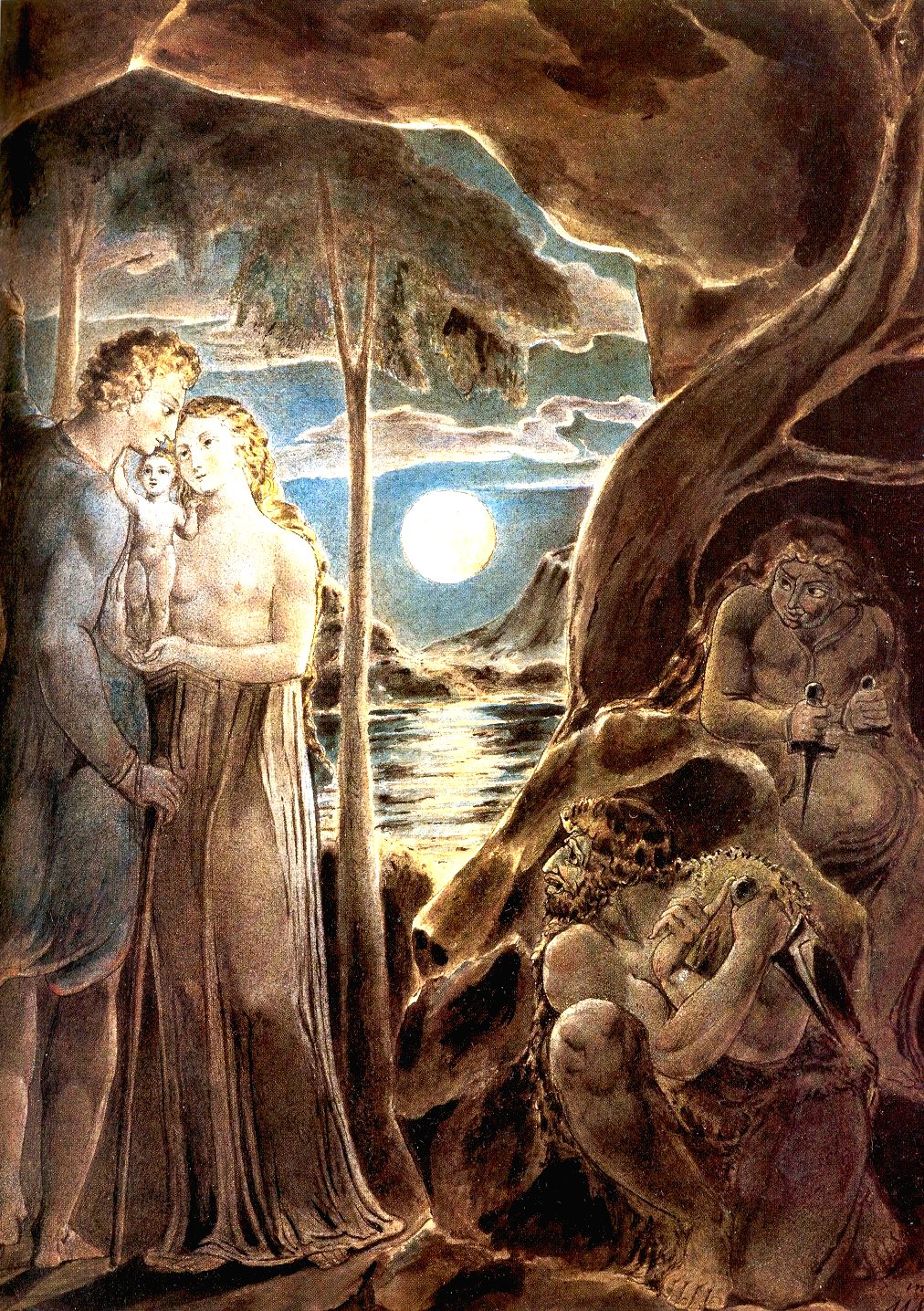
BLAKE DESIGNS

MALEVOLENCE
Letter
To The Revd Dr Trusler

Hercules Build* Lambeth Aug* 16. 1799
Revd Sir
...
I attempted every morning for a fortnight together to follow
your Dictate. but when I found my attempts were in vain. resolvd
to shew an independence which I know will please an Author better
than slavishly following the track of another however admirable
that track may be At any rate my Excuse must be: I could not do
otherwise, it was out of my power!
I know I begged of you to give me your Ideas & promised to
build on them here I counted without my host I now find my
mistake
The Design I have Sent. Is
A Father taking leave of his Wife & Child. Is watchd by Two
Fiends incarnate. with intention that when his back is turned
they will murder the mother & her infant--If this is not
Malevolence with a vengeance I have never seen it on Earth. & if
you approve of this I have no doubt of giving you Benevolence
with Equal Vigor. as also Pride & Humility. but cannot previ-
ously describe in words what I mean to Design for fear I should
Evaporate [some of m] the Spirit of my Invention. But I
hope that none of my Designs will be destitute of Infinite
Particulars which will present themselves to the Contemplator.
And tho I call them Mine I know that they are not Mine being of
the same opinion with Milton when he says That the Muse visits
his Slumbers & awakes & governs his Song when Morn purples The
East. & being also in the predicament of that prophet who says I
cannot go beyond the command of the Lord to speak good or bad
...
Your very humble servt
WILLm BLAKE

Saturday, January 23, 2010

The Last Judgment

It's a scary thing in the eyes of Conventional Religion. Not so for Blake; for him it's Good News.

It's about Sin and Righteousness for them-- Good and Evil; (look at Matthew 25). Not so for Blake; there's no such thing. For him it's about Truth and Error. He acknowledged that good and evil exist; but it doesn't apply to people; you and I can be in a state of Satan, but that will never be a permanent state. ("Good and Evil are Qualities in Every Man"; Erdman 563)

For C.R. the Last Judgment is about the final end of the world. Not so for Blake! For him it's a personal thing that happens often in your life, and it's one-sided. Blake IMO was Universalist rather than narrowly Christian. Look at this verse from the Divine Image:

"And all must love the human form,
In heathen, Turk, or Jew.
Where Mercy, Love, and Pity dwell,
There God is dwelling too."

".......................What are all the Gifts of the
Spirit but Mental Gifts whenever any Individual Rejects Error &
Embraces Truth a Last Judgment passes upon that Individual"
(from Notes on Vision of the Last Judgment, Erdman 562)

You and I and Blake may very well pray for the Last Judgment.

The Last Judgment

It's a scary thing in the eyes of Conventional Religion. Not so for Blake; for him it's Good News.

It's about Sin and Righteousness for them-- Good and Evil; (look at Matthew 25). Not so for Blake; there's no such thing. For him it's about Truth and Error. He acknowledged that good and evil exist; but it doesn't apply to people; you and I can be in a state of Satan, but that will never be a permanent state. ("Good and Evil are Qualities in Every Man"; Erdman 563)

For C.R. the Last Judgment is about the final end of the world. Not so for Blake! For him it's a personal thing that happens often in your life, and it's one-sided. Blake IMO was Universalist rather than narrowly Christian. Look at this verse from the Divine Image:

"And all must love the human form,
In heathen, Turk, or Jew.
Where Mercy, Love, and Pity dwell,
There God is dwelling too."

".......................What are all the Gifts of the
Spirit but Mental Gifts whenever any Individual Rejects Error &
Embraces Truth a Last Judgment passes upon that Individual"
(from Notes on Vision of the Last Judgment, Erdman 562)

You and I and Blake may very well pray for the Last Judgment.

Tuesday, December 1, 2009

Forgiveness for Evil

Blake: 1. "Mutual Forgiveness of each Vice
Such are the Gates of Paradise"
(GP-SexesPrologue2; E259|)

2. "There is not one Moral Virtue that Jesus Inculcated
but Plato & Cicero did Inculcate before him; what then did
Christ Inculcate: Forgiveness of Sins This alone is the
Gospel & this is the Life & Immortality brought to light
by Jesus."

"Forgive us our sins." Quakers don't like to think about
sin, but you must become aware of your sins before
forgiveness can happen. Can you say you haven't sinned
today? this week? I once knew a lady who believed that
she was living above sin; I wondered! Blake said, "There
is none that liveth & Sinneth not!" closely paralleling
Psalm 53:1.

"Lead us not into temptation, but deliver us from evil:"
Blake did not abrogate good and evil. He abrogated the
ideas of good and evil propagated by the conventional
church-- a very different thing. In MHH he identified
with the devil's party (and even gave that appelation to
John Milton), but it was the ventilation of an angry
young man furious at the hypocritic holiness of a
destructive ruling political and religious establishment.

His poetry is full of good and evil, unfortunately more
evil than good, much like Isaiah and the other 'big men';
but like they did, he interposed among the pages of
imprecations some gems of the purest, crystalline
goodness -- no! holiness itself.

People think that the Last Judgment is the greatest Evil,
or at least the great misfortune (yet to come), but Blake
said that the Last Judgment is the greatest blessing
that can come to us, as often as it happens, especially
when we forgive ourselves or someone else.

Good certainly triumphed in Blake's last hour. We're told
he was singing when he died; he obviously heard - or
anticipated - the Heavenly Choir.

Ah those golden bells! even though we never dared to
believe it.

Forgiveness for Evil

Blake: 1. "Mutual Forgiveness of each Vice
Such are the Gates of Paradise"
(GP-SexesPrologue2; E259|)

2. "There is not one Moral Virtue that Jesus Inculcated
but Plato & Cicero did Inculcate before him; what then did
Christ Inculcate: Forgiveness of Sins This alone is the
Gospel & this is the Life & Immortality brought to light
by Jesus."

"Forgive us our sins." Quakers don't like to think about
sin, but you must become aware of your sins before
forgiveness can happen. Can you say you haven't sinned
today? this week? I once knew a lady who believed that
she was living above sin; I wondered! Blake said, "There
is none that liveth & Sinneth not!" closely paralleling
Psalm 53:1.

"Lead us not into temptation, but deliver us from evil:"
Blake did not abrogate good and evil. He abrogated the
ideas of good and evil propagated by the conventional
church-- a very different thing. In MHH he identified
with the devil's party (and even gave that appelation to
John Milton), but it was the ventilation of an angry
young man furious at the hypocritic holiness of a
destructive ruling political and religious establishment.

His poetry is full of good and evil, unfortunately more
evil than good, much like Isaiah and the other 'big men';
but like they did, he interposed among the pages of
imprecations some gems of the purest, crystalline
goodness -- no! holiness itself.

People think that the Last Judgment is the greatest Evil,
or at least the great misfortune (yet to come), but Blake
said that the Last Judgment is the greatest blessing
that can come to us, as often as it happens, especially
when we forgive ourselves or someone else.

Good certainly triumphed in Blake's last hour. We're told
he was singing when he died; he obviously heard - or
anticipated - the Heavenly Choir.

Ah those golden bells! even though we never dared to
believe it.

Wednesday, October 14, 2009

DIVINE MERCY

Blake's Jerusalem, Plate 32, Lines 50-56

"Then those in Great Eternity who contemplate on Death
Said thus. What seems to Be: Is: To those to whom
It seems to Be, & is productive of the most dreadful
Consequences to those to whom it seems to Be: even of
Torments, Despair, Eternal Death; but the Divine Mercy
Steps beyond and Redeems Man in the Body of Jesus Amen
And Length Bredth Highth again Obey the Divine Vision Hallelujah"

Here Blake indicates that we give 'reality' to what seems to be. This 'reality' is evidenced by its consequences. Through the Divine Mercy this situation can be reversed, and we may become those to whom, what seems to be is the Divine Vision.

From this, evil seems to be an illusion caused by failure to participate in the Body of Jesus. Through the Divine Mercy we are released from this illusion. We "shall see reality whole and face to face." (1 Corinthians 13:12b)

Paul's Second Letter to Timothy (Phillips Translation)

1: 6 - "I now remind you to stir up that inner fire which God gave you at your ordination. For God has not given us a spirit of fear, but a spirit of power and love and a sound mind.

1:8-12 - "So never be ashamed of bearing witness to our Lord, nor of me, his prisoner. Accept, as I do, all the hardship that faithfulness to the Gospel entails in the strength that God gives you. For he has rescued us from all that is really evil and called us to a life of holiness - not because of any of our achievements but for his own purpose. Before time began he planned to give us in Christ the grace to achieve this purpose, but it is only since our saviour Jesus Christ has been revealed that the method has become apparent. For Christ has completely abolished death, and has now, through the Gospel, opened to us men the shining possibilities of the life that is eternal."

Don't Blake and Paul both tell us that evil has no grip upon us; that what Jesus has to give to us - that which is Eternal - abolished death and allows us to see the true picture that Christ reveals?

Vala veiled and Jerusalem with three daughters.
.

DIVINE MERCY

Blake's Jerusalem, Plate 32, Lines 50-56

"Then those in Great Eternity who contemplate on Death
Said thus. What seems to Be: Is: To those to whom
It seems to Be, & is productive of the most dreadful
Consequences to those to whom it seems to Be: even of
Torments, Despair, Eternal Death; but the Divine Mercy
Steps beyond and Redeems Man in the Body of Jesus Amen
And Length Bredth Highth again Obey the Divine Vision Hallelujah"

Here Blake indicates that we give 'reality' to what seems to be. This 'reality' is evidenced by its consequences. Through the Divine Mercy this situation can be reversed, and we may become those to whom, what seems to be is the Divine Vision.

From this, evil seems to be an illusion caused by failure to participate in the Body of Jesus. Through the Divine Mercy we are released from this illusion. We "shall see reality whole and face to face." (1 Corinthians 13:12b)

Paul's Second Letter to Timothy (Phillips Translation)

1: 6 - "I now remind you to stir up that inner fire which God gave you at your ordination. For God has not given us a spirit of fear, but a spirit of power and love and a sound mind.

1:8-12 - "So never be ashamed of bearing witness to our Lord, nor of me, his prisoner. Accept, as I do, all the hardship that faithfulness to the Gospel entails in the strength that God gives you. For he has rescued us from all that is really evil and called us to a life of holiness - not because of any of our achievements but for his own purpose. Before time began he planned to give us in Christ the grace to achieve this purpose, but it is only since our saviour Jesus Christ has been revealed that the method has become apparent. For Christ has completely abolished death, and has now, through the Gospel, opened to us men the shining possibilities of the life that is eternal."

Don't Blake and Paul both tell us that evil has no grip upon us; that what Jesus has to give to us - that which is Eternal - abolished death and allows us to see the true picture that Christ reveals?

Vala veiled and Jerusalem with three daughters.
.

Friday, October 9, 2009

BLAKE'S GENERATION

.
From the Book of Genesis

Milton Percival in Circle of Destiny, explains the level or 'world' which Blake calls generation.

"..This is double vision, a correlative of the sexual world of
Generation. The object is outward, corporeal, feminine; the
imaginative image is masculine. Both assert themselves,
each challenging the other's right. The world of generation
might indeed be thought of as a training school in vision.
It may slip back into Ulro, or ascend to Beulah. This is
Los's world, the world of the loins, twofold and sexual;
corporeal, yet struggling to be spiritual" (272-3)

Percival describes the world of generation as Los's world. It
is our world too, a divided world, pulled upward and
downward. The contraries manifest themselves in such
conditions.

"Since there is no chasm, in Blake's system, between man
and nature, the struggle toward regeneration in the natural
world must be thought of, equally with the struggle in the
spiritual world, as the work of Los. Los with his hammer
vehemently constricting, hardening and fixing, eternally
creating only to destroy the false work he has created, is
Blake's dramatization of the process he saw as constantly
at work. For destruction is as essential as creation. For
this reason the natural world is cast in mortal form. Death
and decay are its attributes. It's vegetable life, like Los's
systems, is "continually building and continually decaying."
The invisible fires in which these vegetable forms consume
are the fires of vegetation or generation which also light
the furnaces of Los. Just as the Soul of man is purified in
the "furnaces of affliction," so is the physical world
destroyed and renewed in the fires of "generation or
vegetation." The necessary change is in both cases
accomplished by death in fire."

Blake prefers not to use the terms 'good and evil' in talking
about his worlds because the outcome has already been
decided. Whatever happens along the way, whether it
appears to be constructive or destructive, moves the
process toward wholeness, reintegration, regeneration -
the Eternal completeness in which nothing is lost and
nothing wasted.

BLAKE'S GENERATION

.
From the Book of Genesis

Milton Percival in Circle of Destiny, explains the level or 'world' which Blake calls generation.

"..This is double vision, a correlative of the sexual world of
Generation. The object is outward, corporeal, feminine; the
imaginative image is masculine. Both assert themselves,
each challenging the other's right. The world of generation
might indeed be thought of as a training school in vision.
It may slip back into Ulro, or ascend to Beulah. This is
Los's world, the world of the loins, twofold and sexual;
corporeal, yet struggling to be spiritual" (272-3)

Percival describes the world of generation as Los's world. It
is our world too, a divided world, pulled upward and
downward. The contraries manifest themselves in such
conditions.

"Since there is no chasm, in Blake's system, between man
and nature, the struggle toward regeneration in the natural
world must be thought of, equally with the struggle in the
spiritual world, as the work of Los. Los with his hammer
vehemently constricting, hardening and fixing, eternally
creating only to destroy the false work he has created, is
Blake's dramatization of the process he saw as constantly
at work. For destruction is as essential as creation. For
this reason the natural world is cast in mortal form. Death
and decay are its attributes. It's vegetable life, like Los's
systems, is "continually building and continually decaying."
The invisible fires in which these vegetable forms consume
are the fires of vegetation or generation which also light
the furnaces of Los. Just as the Soul of man is purified in
the "furnaces of affliction," so is the physical world
destroyed and renewed in the fires of "generation or
vegetation." The necessary change is in both cases
accomplished by death in fire."

Blake prefers not to use the terms 'good and evil' in talking
about his worlds because the outcome has already been
decided. Whatever happens along the way, whether it
appears to be constructive or destructive, moves the
process toward wholeness, reintegration, regeneration -
the Eternal completeness in which nothing is lost and
nothing wasted.

Wednesday, September 30, 2009

BLAKE & FORGIVENESS

In the GOSPEL OF MARK we read:

10:17 - As he began to take the road again (after welcoming
the children), a man came running up and fell at his feet,
and asked him, "Good Master, what must I do to be sure of
eternal life?"
10:18-19 - "I wonder why you call me good," returned Jesus.
"No one is good - only God"

We learn from Blake too, that 'good and evil' are terms of
judgment not forgiveness. Even Jesus did not wish to be
called 'good.' Calling him 'good' forces us back into the old
system of law and vengeance. The New Testament teaches
that the alternative to the law is 'the inspiration of the Holy
Spirit' through whom we can love, trust, forgive and hope
for the glorious unfolding of God's grace.

JERUSALEM plate 49

"Because the Evil is Created into a State. that Men
May be deliverd time after time evermore. Amen.
Learn therefore O Sisters to distinguish the Eternal Human
That walks about among the stones of fire in bliss & woe
Alternate! from those States or Worlds in which the Spirit travels:
This is the only means to Forgiveness of Enemies"

In Circle of Destiny Milton Percival explains the beginning of the fall thus:
"The great cosmic break in which the fine relationship of the contraries is destroyed is the work of the Spectre. Blown with pride in his emanative life, he abstracts from it a set of qualities called Good. In his arrogance he believes that these qualities which he admires are due to his own activities; he does not realize that they are but the result of the undisturbed functioning of an harmonious whole."

So partaking of the 'fruit of the tree of good and evil' means naming part of the whole, good and claiming it as one's own. Forgiveness is the reversal of that process. By not claiming good as one's own or as something anyone can possess, we put God who includes all things into the right position. We recognize Evil as a State, not a quality or a human being. Forgiveness loses sight of the State by focusing on the individual as part of the Divine Being.

JERUSALEM Plate 99 Erdman says of this image: "God does not appear as beams of light to outshine the flames of Hell but as a human father welcoming a lost prodigal."

BLAKE & FORGIVENESS

In the GOSPEL OF MARK we read:

10:17 - As he began to take the road again (after welcoming
the children), a man came running up and fell at his feet,
and asked him, "Good Master, what must I do to be sure of
eternal life?"
10:18-19 - "I wonder why you call me good," returned Jesus.
"No one is good - only God"

We learn from Blake too, that 'good and evil' are terms of
judgment not forgiveness. Even Jesus did not wish to be
called 'good.' Calling him 'good' forces us back into the old
system of law and vengeance. The New Testament teaches
that the alternative to the law is 'the inspiration of the Holy
Spirit' through whom we can love, trust, forgive and hope
for the glorious unfolding of God's grace.

JERUSALEM plate 49

"Because the Evil is Created into a State. that Men
May be deliverd time after time evermore. Amen.
Learn therefore O Sisters to distinguish the Eternal Human
That walks about among the stones of fire in bliss & woe
Alternate! from those States or Worlds in which the Spirit travels:
This is the only means to Forgiveness of Enemies"

In Circle of Destiny Milton Percival explains the beginning of the fall thus:
"The great cosmic break in which the fine relationship of the contraries is destroyed is the work of the Spectre. Blown with pride in his emanative life, he abstracts from it a set of qualities called Good. In his arrogance he believes that these qualities which he admires are due to his own activities; he does not realize that they are but the result of the undisturbed functioning of an harmonious whole."

So partaking of the 'fruit of the tree of good and evil' means naming part of the whole, good and claiming it as one's own. Forgiveness is the reversal of that process. By not claiming good as one's own or as something anyone can possess, we put God who includes all things into the right position. We recognize Evil as a State, not a quality or a human being. Forgiveness loses sight of the State by focusing on the individual as part of the Divine Being.

JERUSALEM Plate 99 Erdman says of this image: "God does not appear as beams of light to outshine the flames of Hell but as a human father welcoming a lost prodigal."

Wednesday, September 16, 2009

The Last Judgment

The concept of the last judgment has
driven millions of people out of the
Church, out of Christianity. A fair
number of these refugees from Christianity
have rejected Christendom, not necessarily
a faith in "the Good Lord"; they may pray
nightly but never go near a church.

Some of these "poor benighted souls" have
found refuge among Quakers, who deplore
war, but, more important, believe "there is
that of God in everyone".

The fortunate few, with or without Quakerism,
have found WB, who lampooned Christendom
unmercifully. Urizen,(pic) brought the law, but
who brought grace? Jesus the Forgiveness of
course.

With a few words from Blake's Vision of the
Last Judgment he brought that grossly
misunderstood concept to its merciful
conclusion:

"What are all the Gifts of the
Spirit but Mental Gifts whenever any
Individual Rejects Error & Embraces Truth a
Last Judgment passes upon that Individual."
(Erdman 562)

'Andrew and Simon Peter Searching for Christ'

We don't need to fight Evil (no, no, by
golly), but to reject the Errors that
clutter up our minds; we thus become those
"rich enlightened souls" who join WB in
Heaven.

The Last Judgment

The concept of the last judgment has
driven millions of people out of the
Church, out of Christianity. A fair
number of these refugees from Christianity
have rejected Christendom, not necessarily
a faith in "the Good Lord"; they may pray
nightly but never go near a church.

Some of these "poor benighted souls" have
found refuge among Quakers, who deplore
war, but, more important, believe "there is
that of God in everyone".

The fortunate few, with or without Quakerism,
have found WB, who lampooned Christendom
unmercifully. Urizen,(pic) brought the law, but
who brought grace? Jesus the Forgiveness of
course.

With a few words from Blake's Vision of the
Last Judgment he brought that grossly
misunderstood concept to its merciful
conclusion:

"What are all the Gifts of the
Spirit but Mental Gifts whenever any
Individual Rejects Error & Embraces Truth a
Last Judgment passes upon that Individual."
(Erdman 562)

'Andrew and Simon Peter Searching for Christ'

We don't need to fight Evil (no, no, by
golly), but to reject the Errors that
clutter up our minds; we thus become those
"rich enlightened souls" who join WB in
Heaven.

Tuesday, September 15, 2009

BLAKE AND EVIL

Blake was outspoken in his opposition to oppressive behaviors and to mistaken ideas. Because the enforcement of an external law was the root of much of mankind's suffering, and his inability to perceive the infinite; Blake relentlessly spoke against the law as the construction of Urizen.

The term 'error' was what Blake used to refer to what many call evil. He considered error to be a state and not a person. Error could be brought to light, dealt with and eliminated. Blake's goal was that every person may reach the state of internal unity and brotherhood with man.

Mercy and Truth are met together, Righteousness and Peace have kissed each other
click on picture to enlarge

Athough this passage at first appears to be harsh condemnation, its meaning changes a we look at it in the light of Blake's vocabulary.

InscrDante5; E689|
"Swedenborg does the same in saying that in
this World is the Ultimate of Heaven
This is the most damnable Falshood of
Satan & his Antichrist"

Notice what Blake is saying:
The idea of 'this World' being the 'Ultimate of Heaven' is abhorrent to him, since his whole psyche and philosophy are committed to the notion that Eternity is the only true reality. As always he wouldn't use prosaic language (as I have used) to state this. He states his reaction according to his system of thought.

'Damnable' means being worthy of complete rejection.
'Falsehood' is error - a state which is created so that the individual should not be blamed.
'Satan' is another word for error, he is the "State of Death and not a human existence."(J49:67)

Since in Blake's system, "One Error not remov'd will destroy a human Soul" (J46:11), it is merciful to remove error. Antichrist is that which opposes Christ, another error to be replaced by truth.

Blake doesn't call Swedenborg evil, he says he is in a state of error. What Blake is doing is speaking the truth in as direct and powerful a way as he is capable of.

(Thanks to Damon's A BLAKE DICTIONARY for help in explaining this)

BLAKE AND EVIL

Blake was outspoken in his opposition to oppressive behaviors and to mistaken ideas. Because the enforcement of an external law was the root of much of mankind's suffering, and his inability to perceive the infinite; Blake relentlessly spoke against the law as the construction of Urizen.

The term 'error' was what Blake used to refer to what many call evil. He considered error to be a state and not a person. Error could be brought to light, dealt with and eliminated. Blake's goal was that every person may reach the state of internal unity and brotherhood with man.

Mercy and Truth are met together, Righteousness and Peace have kissed each other
click on picture to enlarge

Athough this passage at first appears to be harsh condemnation, its meaning changes a we look at it in the light of Blake's vocabulary.

InscrDante5; E689|
"Swedenborg does the same in saying that in
this World is the Ultimate of Heaven
This is the most damnable Falshood of
Satan & his Antichrist"

Notice what Blake is saying:
The idea of 'this World' being the 'Ultimate of Heaven' is abhorrent to him, since his whole psyche and philosophy are committed to the notion that Eternity is the only true reality. As always he wouldn't use prosaic language (as I have used) to state this. He states his reaction according to his system of thought.

'Damnable' means being worthy of complete rejection.
'Falsehood' is error - a state which is created so that the individual should not be blamed.
'Satan' is another word for error, he is the "State of Death and not a human existence."(J49:67)

Since in Blake's system, "One Error not remov'd will destroy a human Soul" (J46:11), it is merciful to remove error. Antichrist is that which opposes Christ, another error to be replaced by truth.

Blake doesn't call Swedenborg evil, he says he is in a state of error. What Blake is doing is speaking the truth in as direct and powerful a way as he is capable of.

(Thanks to Damon's A BLAKE DICTIONARY for help in explaining this)

Monday, September 7, 2009

JOB, BLAKE & JUNG

William Blake, Carl Jung and the author of the Book of Job, seem to agree that the experience of Job represented a change in the relationship of man and God.

Job struggles against the perceived injustice of God and the suffering it brings upon him. Job receives a direct intervention from God in the shape of God speaking to him from the whirlwind.

Because Job was truthful with God and confronted God with the human point of view, he received an answer demonstrating God's power, wisdom and mystery. After his trials Job's fortunes are restored and he receives God's favor.

The role that Satan (the personification of evil) plays in the story is pivotal. Satan is allowed by God to test Job because of Job's reputation for righteousness. This perhaps is the hinge of the story because Satan, not God is in charge of testing Job. In the end Job's demands convince God to relate to him directly.

Satan before the Throne of God, Illustrations to the Book of Job (Linnell Set)

Here is a quote from Jung in a letter to Morton Kelsey (from CARL JUNG: WOUNDED HEALER OF THE SOUL by Claire Dunne):

"This is what happens in Job: The creator sees himself through the eyes of man's consciousness and this is the reason why God has to become man, and why man is progressively gifted with the dangerous prerogative of the divine "mind." You have it in Christ's saying: "Ye are gods" and man has not even begun to know himself."

Edward Edinger, in ENCOUNTER WITH THE SELF: A JUNGIAN COMMENTARY ON WILLIAM BLAKE'S ILLUSTRATIONS OF THE BOOK OF JOB describes the encounter of Job with God as "a divine encounter by which the ego is rewarded with some insight into the transpersonal psyche." And he further says "The ego, by holding fast to its integrity, is granted a realization of the Self."

Blake's book, ILLUSTRATIONS TO THE BOOK OF JOB, consists of 21 plates which tell Job's story in a few words and in highly symbolic pictures. Plate 13 represents the encounter of Job with God in the whirlwind which is the intimate experience of a man directly with the numinous. The next plate, number 14, depicts a rebirth of consciousness. The central picture is surrounded with images and words from the creation story in Genesis. The text includes "When the morning Stars sang together & all the sons of God shouted for joy." (Job 38:7) The central image depicts at the top four angels among the stars rejoicing. In the center is kneeling God with outstretched arms and a bright sun-like halo. Beside him are Apollo with the sun, and Artemis with the moon. At the lowest level are Job his wife and the three confronters, who are allowed to witness the celebration of the this new stage of creation. The next seven plates illustrate the changed relationship between Job and God.

Damon in A BLAKE DICTIONARY explains the process Job underwent in terms to going through stages represented by the Seven Eyes of God. In the end "His manhood purged of all error, is now complete."

Each one of us is searching for images to represent indescribable experience.

For links to Blake's illustrations consult the post:
Blake's Pictures for Job

JOB, BLAKE & JUNG

William Blake, Carl Jung and the author of the Book of Job, seem to agree that the experience of Job represented a change in the relationship of man and God.

Job struggles against the perceived injustice of God and the suffering it brings upon him. Job receives a direct intervention from God in the shape of God speaking to him from the whirlwind.

Because Job was truthful with God and confronted God with the human point of view, he received an answer demonstrating God's power, wisdom and mystery. After his trials Job's fortunes are restored and he receives God's favor.

The role that Satan (the personification of evil) plays in the story is pivotal. Satan is allowed by God to test Job because of Job's reputation for righteousness. This perhaps is the hinge of the story because Satan, not God is in charge of testing Job. In the end Job's demands convince God to relate to him directly.

Satan before the Throne of God, Illustrations to the Book of Job (Linnell Set)

Here is a quote from Jung in a letter to Morton Kelsey (from CARL JUNG: WOUNDED HEALER OF THE SOUL by Claire Dunne):

"This is what happens in Job: The creator sees himself through the eyes of man's consciousness and this is the reason why God has to become man, and why man is progressively gifted with the dangerous prerogative of the divine "mind." You have it in Christ's saying: "Ye are gods" and man has not even begun to know himself."

Edward Edinger, in ENCOUNTER WITH THE SELF: A JUNGIAN COMMENTARY ON WILLIAM BLAKE'S ILLUSTRATIONS OF THE BOOK OF JOB describes the encounter of Job with God as "a divine encounter by which the ego is rewarded with some insight into the transpersonal psyche." And he further says "The ego, by holding fast to its integrity, is granted a realization of the Self."

Blake's book, ILLUSTRATIONS TO THE BOOK OF JOB, consists of 21 plates which tell Job's story in a few words and in highly symbolic pictures. Plate 13 represents the encounter of Job with God in the whirlwind which is the intimate experience of a man directly with the numinous. The next plate, number 14, depicts a rebirth of consciousness. The central picture is surrounded with images and words from the creation story in Genesis. The text includes "When the morning Stars sang together & all the sons of God shouted for joy." (Job 38:7) The central image depicts at the top four angels among the stars rejoicing. In the center is kneeling God with outstretched arms and a bright sun-like halo. Beside him are Apollo with the sun, and Artemis with the moon. At the lowest level are Job his wife and the three confronters, who are allowed to witness the celebration of the this new stage of creation. The next seven plates illustrate the changed relationship between Job and God.

Damon in A BLAKE DICTIONARY explains the process Job underwent in terms to going through stages represented by the Seven Eyes of God. In the end "His manhood purged of all error, is now complete."

Each one of us is searching for images to represent indescribable experience.

For links to Blake's illustrations consult the post:
Blake's Pictures for Job

Sunday, December 2, 2007

Exaggeration for Emphasis

People use one (or both) of two basic languages:
1. The vernacular or ordinary
2. Poetic language.

Our Blake spoke the poetic language from birth (as do most babies, but they unfortunately soon lose it). In many places ordinary language is understated: "I don't like him", may announce an intention of killing him.

In contrast poets are free to exaggerate. It may shock us into the truth they mean to convey. Blake was very, very good at that. Sometimes we just have to make allowances, but best of all is to be shocked into the truth.

Now which of these languages do we have here:
Good and Evil are deadly dreams that the Soul may fall into when it leaves Paradise following the Serpent.

Exaggeration for Emphasis

People use one (or both) of two basic languages:
1. The vernacular or ordinary
2. Poetic language.

Our Blake spoke the poetic language from birth (as do most babies, but they unfortunately soon lose it). In many places ordinary language is understated: "I don't like him", may announce an intention of killing him.

In contrast poets are free to exaggerate. It may shock us into the truth they mean to convey. Blake was very, very good at that. Sometimes we just have to make allowances, but best of all is to be shocked into the truth.

Now which of these languages do we have here:
Good and Evil are deadly dreams that the Soul may fall into when it leaves Paradise following the Serpent.